A House Where Nobody Had to Earn Dinner

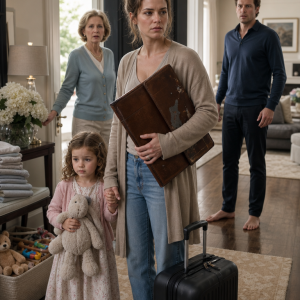
My father was standing in the driveway when we arrived.
He still wore the green work apron from the nursery, with soil across one pocket and pruning shears clipped to his belt.
My mother came running from the porch.
She did not ask what had happened.
She saw my face and wrapped both arms around me.
“You’re home.”
That was all.
Inside, the kitchen smelled like rosemary potatoes and roasted vegetables.
My father crouched beside Emily.
“I heard somebody here likes chicken.”
Emily looked at me before answering.
That tiny glance hurt more than I expected.
She was checking.
Still checking.
“I do.”
Dad opened the oven.
“Then I made four drumsticks.”
Emily stared.
“Four?”
“Four.”
“For everybody?”
My father smiled.
“They can all be yours if you’re hungry enough.”
Emily looked almost suspicious.
“Nobody will get mad?”
My father’s smile faded.
He glanced at me, understood far more than I had explained, then turned back to her.
“Sweetheart, in this house, food is not something you have to earn.”
That evening, I watched my daughter eat without looking around the table after every bite.
I had thought leaving would feel dramatic.
Instead, it felt quiet.
That surprised me most.
Within two weeks, I began helping my parents at the nursery. I rebuilt their outdated inventory system, organized online orders and took evening classes in small-business accounting. For the first time in years, the effort I gave to a household or business did not vanish unnoticed.
People thanked me.
They asked my opinion.
They noticed when I was tired.
Emily began sleeping through the night.
Then Ryan arrived.
He waited beside his car at the end of my parents’ driveway.
I stopped several yards away.
He looked exhausted.
“I watched everything.”
I said nothing.
“Melissa, I was wrong.”
“Yes.”
He seemed surprised by the simplicity of my answer.
“I kept thinking Connor needed me to compensate for the divorce. I was afraid he would think I had chosen a new family over him.”
“So you proved your loyalty to him by making Emily feel unwanted.”
Ryan lowered his head.
“I know.”
“You know now.”
He wiped his face.
“I love you.”
For years, I had imagined hearing those words spoken with that much urgency.
Standing in my parents’ driveway, they barely reached me.
“What did you love, Ryan?”
He stared at me.
“What?”
“Tell me. Did you love me, or did you love the life I made easy for you?”
He opened his mouth but did not answer.
“You loved waking up to coffee. You loved coming home to dinner. You loved knowing Connor’s homework was finished. You loved that I absorbed every insult from your family because arguing with them would have inconvenienced you.”
“That isn’t fair.”
“It’s the fairest question I’ve asked you in five years.”
His shoulders sagged.
“I can change.”
“I hope you do.”
Hope flickered across his face.
I continued.
“But not for me.”
The hope disappeared.
“Change because Connor needs a father who can teach him accountability. Change because Emily deserves a father who understands that love is behavior, not something you announce after someone leaves.”
Ryan looked toward the house.
“Can I see her?”
I called inside.
My mother put Emily on speaker.
“Honey, Daddy is outside. Would you like to come say hello?”
A long pause followed.
Then Emily answered.
“No, thank you.”
Ryan closed his eyes.
He returned the next day carrying toys.
Emily stayed upstairs.
He came once more several days later.
That time, my father stepped outside.
“Ryan, you need to stop coming here uninvited.”
“I just want them to know I’m sorry.”
Dad folded his arms.
“Melissa heard you. Emily heard you. Now respect their answer.”
Ryan looked toward the upstairs windows.
My mother joined my father on the porch.
“If you care about them,” she said quietly, “give them enough peace to heal without having to manage your guilt too.”
Ryan stood there for a long moment.
Then he nodded.
He never appeared at the house without permission again.
The Twenty-Eighth Time
The divorce was finalized several months later.
Ryan stopped contesting the major terms, and I became Emily’s primary custodial parent while professionals helped determine what future contact with her father might safely look like.
I saw Ryan outside the courtroom after everything had been signed.
He looked older.
Not dramatically different.
Just quieter.
“Melissa.”
I turned.
“I know I don’t have the right to ask you for anything.”
I waited.
“Do you think Emily will ever let me be her father again?”
I considered the question.
“That depends on what you mean by being her father.”
He looked confused.
“I mean seeing her. Having a relationship.”
“Then stop thinking of it as something you’re entitled to receive.”
He looked down.
“She’s afraid of me.”
“Yes.”
The word landed between us.
“Does she hate me?”
I shook my head.
“She’s five, Ryan. She isn’t sitting around building a case against you. She remembers how she felt in that house. She remembers being afraid to touch food. She remembers telling the truth and watching you believe someone else.”
His eyes filled.
“What am I supposed to do with that?”
“You live differently for a long time. You become trustworthy without demanding credit for it. And one day, when she is ready, she may notice.”
“And if she never is?”
I pulled my coat around me.
“Then you respect that too.”
I left him standing there.
Outside, the Ohio sky was clear and pale blue.
That evening, my parents’ kitchen was loud.
My mother was arguing cheerfully with my father about whether he had bought too many apples for the farm market. A radio played beside the sink. Someone had left gardening gloves on the counter.
Emily sat at the table coloring a purple horse.
When I entered, she looked up.
“Are the papers finished?”
I smiled.
“They’re finished.”
She climbed out of her chair.
“So this is our house now?”
“This is home.”
Her arms went around my waist.
Then she leaned back.
“Can I have chicken for dinner?”
From the stove, my father turned around holding a wooden spoon.
“Young lady, I already made enough for a small football team.”
Emily laughed.
“Can I have two?”
“You can have two, three, or none. You listen to your stomach.”
She climbed back into her chair and reached confidently for the serving plate.
No hesitation.
No glance around the room.
No apology.
I stood there watching her, and suddenly I understood something I wished I had understood years earlier.
A family is not a group chat.
It is not a surname, a wedding photograph, a house purchased together or an endless record of compromises made by one person.
Family is where a child can reach for dinner without fear.
It is where mistakes are corrected without humiliation.
It is where love does not have to be earned repeatedly from people who already promised to give it.
For months, I had thought being removed from Ryan’s family chat for the twenty-eighth time was the final insult of my marriage.
Eventually, I saw it differently.
The first twenty-seven times, I had waited for him to add me back.
The twenty-eighth time, I finally understood that I had been trying to gain admission to a place where neither my daughter nor I had ever truly been welcomed.
So I stopped asking.
I left the group.
Then I left the house.
And somewhere between my father putting four chicken drumsticks on a kitchen table and my daughter learning she no longer had to ask permission to be hungry, I realized I had not lost a family at all.
I had finally brought my little girl home.