“Rebecca manages youth programs at the country club. She works around children every week. If this becomes a formal matter, she could lose her position.”
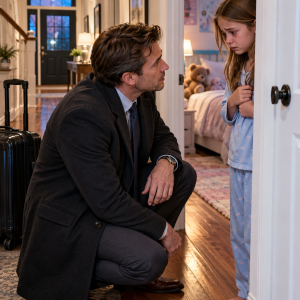
I looked at my daughter.
She was staring down at a half-finished picture of a blue house, but she was no longer coloring.
I walked into the hallway and closed the door.
“You’re more worried about Rebecca’s job than Ellie.”
“That’s not fair.”
“It’s exactly what you just said.”
“Your mother and I are trying to keep the family together.”
I lowered my voice.
“No. You’re trying to keep the truth quiet.”
That afternoon, I forwarded everything to the child-welfare specialist: the photographs from the medical visit, my mother’s note, Rebecca’s messages, and a written account of my father’s call.
Two days later, a county investigator came to my house.
He sat at my kitchen table with a plain black folder and listened without interrupting. When I finished, he reviewed the messages slowly.
Then he said something I would remember for a long time.
“Keep every record. People often think the truth needs to arrive loudly. Usually, it arrives in pieces.”
I had no idea how many pieces were already waiting.
Eighteen Seconds

Three nights later, my cousin Nathan called.
Nathan was not someone who involved himself in family conflict. He installed residential security systems for a living, spoke very little at gatherings, and usually left before dessert. At Paige’s party, my parents had asked him to adjust two outdoor cameras because they had been having trouble with the backyard connection.
His voice sounded uneasy.
“Mason, I need to tell you something, and I’m not looking to get in the middle of whatever is happening.”
I sat up straighter.
“Okay.”
“I checked the terrace footage from Saturday.”
For a moment, I said nothing.
“Why?”
“Your dad called me. He wanted to know whether the camera showed Ellie falling.”
That sentence told me more than my father probably intended.
“Did it?”
Nathan exhaled.
“No.”
My heart began pounding.
“What does it show?”
“Rebecca taking Ellie toward the house. Ellie is walking normally. She isn’t running. She isn’t throwing herself around. She looks upset, but that’s it.”
I stood from the couch without realizing I had moved.
“Anything else?”
Nathan was quiet for several seconds.
“There’s audio.”
He sent me the clip.
Eighteen seconds.
That was all.
In the video, the backyard looked bright and ordinary. Children moved near the balloon arch. An adult crossed the frame carrying napkins. Then Rebecca appeared, gripping Ellie’s arm as she led her toward the house.
My daughter was not having the dramatic outburst Rebecca had described.
She was simply crying.
Just before they passed through the door, Rebecca’s voice came through clearly.
“You’re going to learn not to ruin my daughter’s day.”
The door closed.
A moment later came a sharp sound from inside, followed by Ellie’s frightened crying.
The camera did not show what happened beyond the doorway.
It did not need to explain everything by itself.
There was the medical documentation.
There were the visible marks.
There was Ellie’s hiding place.
There were Rebecca’s messages asking me to give a false explanation.
There was my mother’s note.
There was my father’s concern about the camera footage.
And now there were eighteen seconds that directly contradicted the story they had told.
I sat alone in my living room and played the clip once more.
Then I stopped.
I did not need to hear it again.
The Story That Kept Changing
The investigator received the video the following morning. So did the child-welfare specialist.
After that, Rebecca’s explanation began changing.
First, she maintained that Ellie had slipped.
Then she claimed Ellie had dropped to the floor during a tantrum.
Later, she admitted that she had been trying to “correct” Ellie because, in her words, no one else had taught the child proper limits.
My parents insisted they had witnessed nothing.
Strangely, that hurt more than I expected.
Some small, foolish part of me had believed that once they saw the evidence, they would stop thinking about reputation and start thinking about their granddaughter.
They did not.
My mother called one evening.
She was crying before I even said hello.
“Mason, please. Rebecca could lose everything she has worked for. Do you understand what a formal investigation can do to someone’s career?”
“Yes.”
She seemed relieved for half a second.
Then I continued.
“It means someone is finally looking closely at what all of you wanted me to ignore.”
“She made a mistake.”
“A mistake is forgetting an appointment. A mistake is breaking a plate. This was a frightened child being treated badly, followed by several adults asking her father to repeat a story they knew was not true.”
My father took the phone.
“You’re being cruel.”
The word almost made me laugh, though nothing about that evening was funny.
Cruel was a six-year-old hiding in a utility room and wondering whether she owed an apology.
Cruel was a grandmother leaving a note about protecting one daughter without asking about her granddaughter.
Cruel was a grandfather worrying about a professional title before asking whether a child felt safe.
I closed my eyes.
“Do not contact Ellie.”
Silence.
Then my mother spoke again, her voice barely above a whisper.
“Are you taking our granddaughter away from us?”
I looked through the doorway toward the living room, where Ellie was building a crooked tower from wooden blocks.