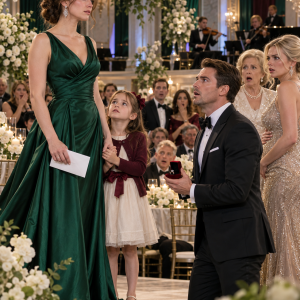
The Day I Followed My Son-in-Law

The first time my granddaughter told me to follow her father, I assumed she had misunderstood something.
Lucy was only eight, small for her age and serious in the way children sometimes become when they have spent too much time around adults carrying things they do not explain. We were sitting beneath the old maple behind my hardware store in a quiet Pennsylvania town when she leaned toward me and said, “Grandpa, next Thursday, when Dad says he’s going to Pittsburgh for work, follow him.”
I laughed at first.
“That sounds a little sneaky.”
She did not laugh with me.
“Please. Don’t tell him. Just see where he goes.”
Her expression stayed with me for six days.
For nearly seven years, Lucy and her father, Nathan Mercer, had been the remaining pieces of my daughter Emily’s family. Emily had been thirty-two when a highway accident during a heavy autumn storm took her from our lives—or so every official document, investigator, and medical report had told us.
My wife, Claire, never completely accepted it.
For months she questioned details I had trained myself not to question because certainty, even painful certainty, seemed easier to live with than hope. Claire made calls, wrote names in notebooks, and once told me she was not convinced every part of the identification had been handled properly.
I told her to stop.
That remains one of the conversations I wish I could have back.
Claire passed away the following year after a sudden medical emergency, and after that, grief became less like a storm and more like weather. It was simply there, woven into everything.
Every January I transferred thirty-five thousand dollars to Nathan for Lucy. Emily had once made me promise that if anything ever happened to her, I would make sure her little girl was secure. Money was something I understood. I could save it, transfer it, account for it. It gave me the comforting illusion that I was still keeping my promise.
Nathan never asked for the money, but he accepted it, thanked me, and raised Lucy with a devotion I could see for myself.
Which was why following him felt ridiculous.
Still, on Thursday morning, I closed the store early and parked across from his neighborhood.
Nathan left shortly after nine.
He did not drive west toward Pittsburgh.
He drove north.
Forty-five minutes later, he pulled into the parking lot of a low brick building surrounded by pine trees. The sign near the entrance read:
CEDAR GLEN COGNITIVE REHABILITATION CENTER.
I remained in my truck, confused, until a woman came through the front doors.
Nathan stepped out carrying two coffees.
Then I saw her face.
For several seconds, my mind refused to understand what my eyes were telling it.
The woman was thinner than I remembered, her hair shorter and streaked with gray near the temples, but I knew the shape of her shoulders. I knew the way she tilted her head when someone spoke. I knew the faint dimple in her left cheek.
I had watched that face grow from infancy into adulthood.
It was Emily.
My daughter.
The child I had mourned for seven years was standing forty yards from me beneath a pale October sky.
My hand went immediately to the door handle.
Then Lucy’s voice returned.
Just watch.
So I watched.
Nathan handed Emily a coffee. She smiled faintly. He opened a folder and showed her several pages. Nothing about them looked secretive or romantic. If anything, they looked exhausted.
A few minutes later, they went inside.
I sat there until Nathan eventually came back out alone and drove away.
Then I crossed the parking lot.
The receptionist was polite until I gave Emily’s name.
Her expression became professionally careful.
“And your relationship to Ms. Mercer?”
My mouth felt dry.
“I’m her father.”
She hesitated.
“Sir, I’m not permitted to confirm information about residents without authorization.”
“I just saw her.”
“I understand.”
“No, I don’t think you do. My daughter has been gone for seven years.”
The receptionist’s face softened, but before she could answer, I heard a voice behind me.
“Dad?”
I turned.
Emily stood at the end of the hallway beside a woman wearing a Cedar Glen identification badge.
For a moment neither of us moved.
Then Emily whispered it again.
“Dad.”
There are moments a person imagines so many times that reality should feel familiar when it arrives. It does not.
I had imagined hearing Emily’s voice again on hundreds of lonely evenings, especially after Claire was gone and the house became too quiet. In those imaginary reunions I always knew exactly what I would say.
Standing there, I could say nothing.
Emily took one uncertain step toward me.
That uncertainty hurt almost as much as the years between us.
My daughter had once entered my house without knocking, stolen food from my refrigerator, criticized my shirts, and called me whenever something in her apartment made a strange noise because she believed owning a hardware store somehow made me an expert on every appliance manufactured since 1950.
Now she looked as though she needed permission to touch me.
I opened my arms.
She crossed the space between us slowly.
When I held her, the first thing I noticed was how small she felt.
“You’re here,” I whispered.
“I’m sorry, Dad.”
“You’re really here.”
“I’m sorry.”
For those first few minutes, I did not ask where she had been or why Nathan had hidden her from me.
I simply held my daughter.
Seven Years That Nobody Could Give Back
The woman with Emily was Dr. Rachel Monroe, a rehabilitation psychologist who had worked with her for almost two years.
We moved into a quiet family room, where Emily sat across from me twisting a tissue between her fingers.
I studied every familiar detail of her face: the tiny mark above her eyebrow from falling off a bicycle at ten, the dimple Claire always said she inherited from her grandmother, and the nervous habit of rubbing her thumb against her index finger.
“Tell me what happened,” I finally said.
Dr. Monroe explained slowly.
On the night of the highway accident, Emily had not been alone. A coworker had been riding with her. During the storm, Emily’s car left the road and came to rest beyond an embankment.
The other woman had remained near the vehicle.
Emily had been found much farther away hours later, unconscious and without identification.
Her purse, coat, phone, and jewelry were still near the car.
Those belongings became the foundation for an assumption that should have been questioned more carefully.
Meanwhile, Emily was taken to another hospital as an unidentified patient. Her injuries had severely affected memory, speech, and coordination. For weeks she could not reliably provide even her own name.
Then came transfers between counties, incomplete databases, one incorrectly entered birth date, and years in which Emily herself could offer only fragments.
A yellow kitchen.
Cinnamon.
A little girl.
A hardware store with an old maple tree behind it.
She remembered images but could not assemble them into a life.
Then, eighteen months earlier, one memory had become clear enough to investigate.
Bennett & Daughter Hardware.
My store.
A social worker found our website and an anniversary photograph showing me, Nathan, and Lucy.
Because Nathan was still legally listed as Emily’s husband, he was contacted first.
I stared at him when he arrived at Cedar Glen twenty minutes later.
“Eighteen months?”
Nathan looked older than forty-one.
“Yes.”
“You knew for eighteen months that Emily was here while I was visiting a memorial with her name on it?”
“Yes.”
The calmness of his answer made my anger rise.
“Why?”
He looked at Emily.
She answered instead.
“Because I asked him not to tell you.”
That stopped me.
“You were afraid of me?”
“Not of you. Of becoming somebody everyone expected me to remember.”
Her voice trembled.
When Nathan first came, she explained, she recognized something about him before she understood who he was. Photographs came later. Pictures of Claire were especially difficult because Emily could not understand that her mother was no longer here.
Then Nathan showed her photographs of Lucy.
The baby Emily remembered had become a school-aged child.
“It felt like people were showing me another woman’s life,” Emily said, “and telling me I had to step into it.”
Dr. Monroe explained that memory did not return like a light being switched on. It came unevenly, sometimes in tiny pieces, and forcing too much information at once could leave Emily confused for days.
Nathan began visiting weekly.
Eventually, he brought Lucy.
I nearly stood up.
“Lucy knew?”
“She visited three times,” Nathan said. “With the counselor present every time.”
Suddenly my granddaughter’s strange request made sense.
She had been carrying a truth the adults around her were still trying to manage.
“You put this on an eight-year-old?”
Nathan shook his head.
“I shouldn’t have allowed the situation to reach that point. That’s on me.”
Emily reached toward me.
“And me. I thought I needed more time.”
Lucy had apparently grown tired of waiting for the adults to become brave.