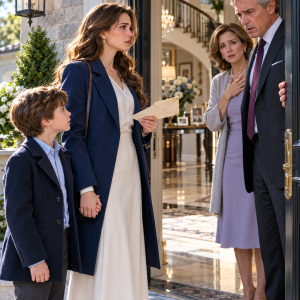
“Then help Rebecca.”
“You and Ethan are doing well.”
That sentence landed harder than I expected.
“So because we’ve worked hard and managed our money carefully, our children deserve less consideration?”
“That’s not what I said.”
“It’s what your decision communicated.”
Dad became quiet.
I wasn’t expecting a breakthrough, and none came.
He didn’t suddenly confess to decades of favoritism.
He didn’t deliver the perfect apology.
Real families rarely resolve themselves that neatly.
But before we ended the call, his voice had lost some of its certainty.
“I didn’t think they’d take it personally.”
“They’re children, Dad. Of course they took it personally.”
I mailed the check back.
Not because we didn’t need money.
With three children, there is always something that fifteen hundred dollars could improve.
I returned it because accepting it would have allowed my father to believe that the amount had been the issue.
It wasn’t.
The issue was belonging.
The Sister I Had Blamed for Too Long
We skipped Christmas dinner at my parents’ house that year.
Instead, we stayed home.
Ethan cooked far too much food, Grace chose the music, Caleb built an elaborate cardboard fort in the living room, and Sophie wore a sparkly dress with fuzzy socks because she insisted Christmas required elegance but cold feet were unreasonable.
It was imperfect and wonderful.
My parents called in the afternoon.
The conversation was polite.
The children thanked them for the small packages that had arrived on Christmas Eve—books, puzzles and gift cards, modest presents that somehow meant more because no one had pretended they were impossible.
Then January came.
Three weeks after Christmas, Rebecca called.
I nearly ignored her.
We hadn’t spoken directly since the video.
When I answered, her voice was unusually tentative.
“Hey.”
“Hey.”
“Do you have a minute?”
“Sure.”
She exhaled.
“Mom told me what happened.”
I waited.
“I didn’t know, Claire.”
“Didn’t know what?”
“That Dad told you they couldn’t afford presents for your kids.”
I leaned against the kitchen counter.
Rebecca continued quickly.
“Mom told me they wanted to help because Daniel’s business had been slow. She said Dad had set aside some extra retirement money and they wanted to make Christmas easier for us. I knew the gifts were excessive, but I thought they were doing things for your kids too.”
For weeks I had carried anger toward my sister because anger was simpler when it had a clear destination.
Suddenly, that certainty disappeared.
“You really didn’t know?”
“I swear.”
Her voice cracked.
“When Mom finally told me, I felt awful. I called her and asked what she was thinking.”
I sat down.
“What did she say?”
Rebecca gave a humorless little laugh.
“She said you and Ethan didn’t need help.”
Of course.
There it was again.
Need.
As though affection were emergency assistance to be distributed according to financial hardship.
“That’s pretty much what Dad told me.”
“I told them that’s not how grandchildren work.”
Something tightened in my throat.
Rebecca and I had spent much of our adult lives circling each other carefully.
I had resented her for being favored.
She had resented me for being the responsible one our parents compared her against whenever she struggled.
Neither of us had understood that we were standing on opposite ends of the same unhealthy pattern.
“I’m sorry,” she said.
“You don’t have to apologize for accepting presents.”
“Maybe not. But I should’ve noticed more over the years.”
I looked out the kitchen window.
“So should I.”
She was quiet.
Then she said, “I always thought you were the one they trusted more.”
I almost laughed.
“And I thought you were the one they loved more.”
That silence felt different from the others.
Softer.
Rebecca finally said, “Maybe they just gave us different problems.”
That was probably the truest thing either of us had said.
We talked for nearly two hours.
Not just about Christmas.
About childhood.
About the family roles neither of us had chosen.
She admitted that being constantly rescued by our parents had sometimes made her feel incapable, while I admitted that being praised for needing nothing had made asking for help almost impossible.
Neither of us had been given exactly what we needed.
We had simply been hurt in different directions.
Before hanging up, Rebecca said, “Next Christmas, let’s make our own plans before Mom and Dad start arranging everything.”
I smiled.
“I’d like that.”
A Different Kind of Tradition

Nearly a year has passed since that Christmas, and my relationship with my parents is different now.
Not ruined.
Different.
We speak.
We visit occasionally.
The children still know and love their grandparents, although Ethan and I are more careful about situations where comparisons might arise.
My parents have made some effort, too.
Dad is still uncomfortable talking about feelings and probably always will be, but he has started calling the children individually, asking about school and remembering events without relying on me to remind him.
Mom came to Grace’s spring recital and drove home the same night rather than saying the distance was too inconvenient.
Small things.
But after years of small hurts, I have learned not to dismiss the importance of small repairs.
Rebecca and I are closer than we have been since we were teenagers.
Sometimes we laugh about the irony that our parents’ worst Christmas decision finally forced us to stop seeing each other as competitors.
The children remember almost none of the conflict.
When they talk about that Christmas, they remember Florida.
Caleb remembers riding the same roller coaster four times.
Grace remembers staying up late with Ethan eating ice cream outside the hotel.
Sophie remembers fireworks and insists, inaccurately but passionately, that one of them was shaped exactly like her stuffed rabbit.
They don’t talk about the presents they didn’t receive.
They certainly don’t remember the price of anything.
And perhaps that was the lesson I needed most.
For years, I believed keeping a family together meant absorbing discomfort quietly, overlooking unfairness and making sure everyone else remained comfortable, because that was what mature, reasonable people supposedly did.
I don’t believe that anymore.
Families need grace, certainly.
They need forgiveness.
They need patience.
But healthy love also needs honesty, because kindness without boundaries eventually becomes permission, and peace that depends entirely on one person remaining silent isn’t really peace at all.
Last month, Mom called to ask what we wanted to do for Christmas this year.
For once, she didn’t announce a plan.
She asked.
I told her Rebecca’s family was coming to our house for Christmas Eve, and my parents were welcome too.
There would be no expensive gifts.
Each adult would bring one present for each child, with a spending limit everyone had agreed upon.
Mom was quiet for a second.
Then she said, “That sounds fair.”
Such an ordinary sentence.
A year earlier, I might not even have noticed it.
Now I understood what it represented.
Not perfection.
Not a miraculous transformation.
Just a family slowly learning that love shouldn’t require one person to disappear so everyone else can remain comfortable.
On Christmas morning, after everyone leaves, Ethan and I plan to stay home with the children.
No elaborate trip this time.
No statement to make.
We’ll wear pajamas too late into the afternoon, make pancakes, leave dishes in the sink and probably watch the same holiday movie we’ve seen dozens of times.
Grace will pretend she’s too old for half our traditions and participate in every one of them anyway.
Caleb will eat more whipped cream than pancakes.
Sophie will probably give her stuffed rabbit a seat at the table.
And somewhere in the middle of all that ordinary noise, I know I’ll remember the Christmas when my father told me money was tight.
For a while, I thought that Christmas was about being excluded.
It wasn’t.
It was the year I finally understood that I didn’t need to spend my life asking other people to choose my family.
I could choose them myself.
I could build traditions around the people who showed up with kindness rather than comparison, and I could teach my children that being loving did not mean accepting less respect than everyone else.
Most importantly, I could stop measuring family by invitations, presents or places at somebody else’s table.
Sometimes growing up happens long after childhood ends.
Sometimes it happens in a kitchen, staring at a message you wish you had never received.
Sometimes it happens beneath fireworks, with your child’s hand wrapped around yours.
And sometimes the family tradition worth keeping isn’t the one you inherited.
It’s the one you finally become brave enough to create.