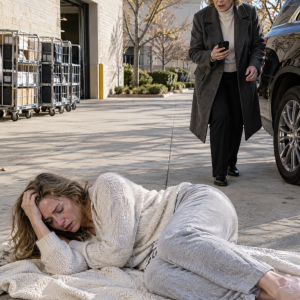
“I never meant for you to find out that way.”
I stared at him.
“How exactly did you expect me to find out?”
He couldn’t answer.
“Were you actually going to marry her?”
He rubbed both hands across his face.
“I convinced myself our marriage had already ended emotionally.”
“Then why did you text me that morning?”
Silence.
“Why did you call me your wife?”
His eyes lowered.
“Because I still loved you.”
“And you loved her?”
“Yes.”
I nodded slowly.
The answer hurt, but it also clarified everything.
“No, Graham. You didn’t want to choose between us. You wanted the quiet marriage with me, the public life with her, and the freedom to avoid losing either one.”
He didn’t argue.
Finally, he whispered:
“I’m sorry.”
“So am I.”
“Can we fix this?”
I shook my head.
“I filed for divorce yesterday.”
The Woman Who Thought We Were Rivals
A month later, Kendra contacted me.
We met at a small coffee shop in Richmond.
For the first time since high school, she wasn’t trying to impress me.
She looked tired.
“I really didn’t know,” she said.
“I believe you.”
She stared into her coffee.
“But after I found out, I still blamed you for about ten minutes.”
“I noticed.”
A weak smile crossed her face.
“I’m sorry.”
Then she admitted something stranger.
The wedding invitation had partly been about me.
She wanted me there because she had spent years believing she needed to prove that she had succeeded more than I had.
“I thought marrying Graham meant I had finally won.”
I frowned.
“Won what?”
Kendra laughed sadly.
“Exactly. That’s what took me twenty years to understand. You didn’t even know we were competing.”
We didn’t become friends.
We didn’t need to.
But when we left that café, I no longer saw her as the woman who had stolen my husband.
Graham had deceived both of us.
The Signature That Finally Ended It
Our divorce was completed several months later.
We had no children, and our finances were mostly separate, so the process was simpler than people expected.
Graham signed the final page and stared at the document.
“Three years disappear with one signature.”
I shook my head.
“They didn’t disappear today.”
He looked at me.
“When did our marriage end for you?”
I remembered the vineyard.
The flowers.
Kendra’s dress.
Graham stepping from the SUV.
And the fear on his face when he saw me.
“The moment you looked at me and immediately searched for an escape.”
He lowered his eyes.
“That’s when I understood you weren’t frightened because you had hurt me. You were frightened because the two lives you created had finally entered the same room.”
For a long moment, neither of us spoke.
Then Graham asked:
“If I’d simply asked you for a divorce before Kendra, would you have hated me?”
“No.”
He looked surprised.
“It would’ve hurt. I probably would’ve cried. But eventually I would have respected you for telling me the truth.”
That seemed to hurt him more than anything else.
Because the entire disaster had been unnecessary.
He had always been free to leave.
He simply wanted to leave without giving anything up.
Three Years Later
Three years after that wedding, my life looked different.
Not because I became louder.
Not because I suddenly began sharing everything online.
I simply stopped treating my personal life as something that could always wait.
I visited my mother more often.
I took vacations.
I answered messages from people who mattered.
I learned that independence wasn’t the same as isolation.
My absences never excused Graham’s choices.
But I also realized I didn’t want to spend the rest of my life promising myself I would make time for people “later.”
One afternoon, my old high school group started planning a reunion.
Someone tagged me.
Kendra responded with a laughing emoji.
Then she wrote:
“Audrey, you have to show up this time. Apparently important things happen when you do.”
I laughed.
Then I typed:
“I’ll try.”
For years, people had mistaken my privacy for failure.
Kendra thought I had nothing worth showing.
Old classmates assumed I had disappeared because my life hadn’t turned out well.
Graham made the most dangerous assumption of all.
He believed that because nobody could see his wife, he could behave as though he didn’t have one.
He thought my absence meant I would always be somewhere else.
Working.
Traveling.
Too busy to notice.
But on the one day he needed me to remain invisible, I did something I almost never did.
I took the day off.
And I showed up.
I didn’t have to shout.
I didn’t have to humiliate anyone.
I didn’t have to destroy another woman to prove that I had been wronged.
I simply walked into the room.
Sometimes a lie survives for years not because it is brilliant, but because the one person who knows the truth hasn’t entered the room yet.
And when I finally did, everyone discovered the same thing.
Graham Sterling wasn’t about to get married.
He already had a wife.
Sometimes the strongest response to betrayal is not raising your voice, but standing calmly in the truth and allowing another person’s choices to speak for themselves.
A relationship can survive distance, demanding careers, difficult seasons, and long absences, but it cannot remain healthy when honesty becomes something one person believes is optional.
When someone creates different versions of themselves for different people, the truth eventually becomes impossible to control because separate worlds have a way of meeting.
Never confuse privacy with weakness, because the person who says the least may still understand far more than others realize and may simply be waiting for the right moment to speak.
You do not need to compete with another person for someone who genuinely respects you, because real love should never require two people to fight for a place that was promised honestly.
Being hurt does not require you to become cruel, and sometimes walking away with your dignity intact is a more powerful ending than any public argument could ever create.
Honesty may cause temporary pain, but deception often creates consequences far larger than the truth someone was originally afraid to tell.
A successful life should never be measured by whether other people appear to have less, because constantly searching for someone beneath you prevents you from appreciating what is already beside you.
Loving your career and being independent are valuable strengths, but the people who matter deserve time in the present rather than endless promises that you will make room for them someday.
Some of life’s biggest turning points begin with one simple decision to show up, because the truth does not always need a dramatic entrance—it only needs to be present where the lie expected it to remain absent.