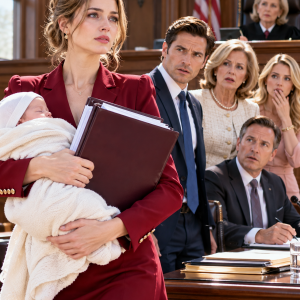
Nolan finally sat down.
His face had gone pale.
“And Laurel?”
Everett looked toward me.
“Laurel has an ownership interest represented through the Whitaker family trust.”
Sabrina slowly removed her hand from Nolan’s arm.
What I Chose
I could have made the meeting personal.
I did not.
I did not block Nolan’s project out of revenge.
I did not demand an unreasonable price.
I did not humiliate him in front of his employees.
Instead, I supported a revised agreement requiring the development to preserve affordable retail spaces for existing local businesses and contribute to public improvements around the site.
Those were ideas Nolan himself had believed in when we first met.
Somewhere along the way, he had abandoned them.
I had not.
When the meeting ended, Sabrina left first.
Nolan stayed behind.
For several seconds, neither of us spoke.
Then he said quietly:
“So all those years, you had money.”
I shook my head.
“That’s still what you think this is about?”
“What else am I supposed to think?”
“Think about the fact that when we met, you had almost nothing and I loved you anyway.”
His eyes dropped.
“I could have helped you sooner,” I continued. “I chose not to because you were proud of building something yourself. I respected that.”
He looked toward the closed conference-room door.
“Why didn’t you tell me after we got married?”
I thought about all the possible answers.
Then I gave him the simplest one.
“Because every year I hoped I would finally feel safe enough to tell you.”
He looked at me then.
And for once, Nolan had nothing clever to say.
The Life I Thought I Wanted
Six months after the divorce, I moved into a townhouse overlooking a small park.
It was not the largest property available to me.
Everett thought that was funny.
“You could live almost anywhere,” he reminded me.
“I know.”
“And you picked a place where your neighbor’s dog steals your newspaper.”
“His name is Murphy.”
Everett laughed.
I began working with the Whitaker Foundation on community development programs.
For the first time, I used the experience I had quietly gathered during years of helping Nolan from the sidelines.
I discovered something important.
I had spent so long believing I was supporting someone else’s dream that I had forgotten I was capable of building my own.
One Saturday morning, I received a message from Nolan.
He and Sabrina had separated.
I stared at the screen for a while.
Then another message appeared.
“I owe you an apology for more things than I know how to put into one message.”
I did not answer immediately.
Not because I hated him.
I simply no longer needed anything from him.
Later that evening, I wrote back.
“I hope you become someone you can respect when no one is watching.”
That was all.
What He Finally Understood
Nearly a year after the divorce, I saw Nolan again at the opening of a neighborhood business center connected to the revised development.
He looked older.
Not dramatically.
Just enough that I could see life had humbled him.
He approached me after the ceremony.
“You look happy.”
“I am.”
He nodded.
Then he looked toward the renovated storefronts behind us.
“You know what bothers me most?”
I waited.
“I thought you needed me.”
His voice carried no arrogance this time.
“And because I thought you needed me, I stopped appreciating that you chose me.”
For the first time in a long while, I remembered the young man with the broken truck window.
The man I had once believed I would grow old beside.
I smiled gently.
“That’s probably the closest you’ve ever come to understanding it.”
He nodded.
There was nothing else to say.
I walked toward Everett, who was waiting beside the entrance.
Nolan did not follow.
And that was how our story truly ended.
Not with the divorce papers.
Not with the black car.
Not with billions of dollars or a conference room full of attorneys.
It ended when I finally understood that leaving with my dignity was never the same thing as leaving with nothing.
Sometimes the person who appears to walk away with nothing is actually leaving with the one thing money cannot replace: the freedom to rebuild a life without constantly proving their worth to someone who stopped seeing it.
Never confuse another person’s quietness with weakness, because some people do not announce their strength; they simply make careful decisions and allow time to reveal what arguments never could.
Love should never depend on wealth, status, family connections, or usefulness, because the moment affection requires those things, it becomes a transaction instead of a relationship.
The people who supported you before success deserve even more respect after success arrives, because character is often revealed by how we treat those who stood beside us when there was nothing impressive to offer.
Walking away calmly does not mean a person feels nothing; sometimes it means they have already spent months processing the disappointment and finally understand that another argument will not repair what respect could not protect.
A person can forgive many mistakes, but once they realize they are consistently being taken for granted, even years of memories may no longer be enough to convince them to remain where they feel invisible.
Financial independence can provide choices, but self-respect provides direction, and having both means very little unless a person also has the courage to choose a life that brings peace rather than appearances.
Success should make us more grateful for the people who helped us reach it, not more eager to replace them with people who only appeared after the difficult years were already over.
Sometimes losing someone is the only event powerful enough to make us understand how much they quietly contributed, but recognition that arrives after respect disappears may come too late to restore what was broken.
The strongest ending is not always revenge, regret, or watching someone else fail; sometimes it is simply reaching a place where their choices no longer determine your happiness, your confidence, or the future you choose for yourself.