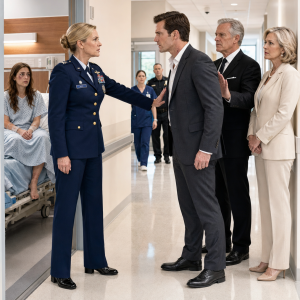
“She couldn’t breathe. I was helping her.”
The nurse examined me while Lorraine’s voice rose.
“You don’t understand what this woman has done to my son!”
Detective Mercer waited until the officers had escorted her from the room. Then he returned carrying a worn brown file.
“Evelyn, the threat she made may connect to something older.”
He opened the file and placed a faded photograph on my tray.
A younger Graham stood outside a lakeside inn with his arm around a woman I had never seen. Lorraine was beside them, smiling beneath a wide summer hat. The woman wore an ivory dress and held a small bouquet.
Written on the back was a date from six years before Graham and I met.
Under it were four words:
Graham and Rebecca’s wedding.
The Wife No One Mentioned

I stared at the photograph until the faces seemed to shift.
“Graham has never been married before.”
Detective Mercer’s expression remained careful.
“That’s what he told you.”
The woman in the picture was Rebecca Sloan, a former elementary-school counselor who now lived in coastal Maine. She had married Graham eight years earlier. Their marriage lasted less than two years and ended after she fell down an exterior staircase at Lorraine’s vacation home near Lake Lure.
Rebecca survived with serious injuries to her hip and lower back.
At first, she told police that Graham had shoved her during an argument. Three days later, she withdrew the accusation and said she might have lost her footing.
“Why did she change her statement?” I asked.
Detective Mercer turned several pages. One was a copy of a nurse’s observation from Rebecca’s hospital file.
Patient becomes visibly distressed following visits from husband’s mother.
“Lorraine visited her repeatedly,” he said. “Rebecca stopped cooperating soon afterward.”
“Have you spoken to her?”
“This morning. She has agreed to give a new statement.”
Before I could ask more, the door opened and Graham entered with two officers behind him. His tie was missing, his hair was disordered, and his face wore the practiced concern I had seen him use with physicians, relatives, and anyone else whose sympathy he required.
“Evelyn, are you all right? They told me something happened.”
Then he saw the photograph.
All color left his face.
Detective Mercer said one name.
“Rebecca.”
Graham stopped beside the bed.
“Evie, I can explain that.”
“Explain why you told me I was your first wife.”
“That marriage was erased from my life for a reason.”
“A legal marriage doesn’t disappear because you stop discussing it.”
He looked toward the officers.
“Rebecca had emotional problems. The relationship ended badly, and I didn’t want her history poisoning what we had.”
“Did she fall after discovering you were seeing someone else?”
His jaw tightened.
“This has nothing to do with what happened to you.”
“Then tell Detective Mercer where you were when I went over the terrace.”
“Downstairs.”
“You were standing behind me.”
“You were frantic. You pulled away when I tried to calm you.”
“You put your hand on my shoulder.”
Graham looked at Detective Mercer and asked for an attorney. It should have ended the conversation, but as an officer stepped forward, Graham glanced at the photograph and made the mistake that changed the direction of the investigation.
“My mother had no right to interfere again.”
Detective Mercer raised his head.
“Again?”
Graham’s mouth opened, but no answer came.
After he was escorted out, I asked to see the rest of the file.
The detective hesitated before showing me printed messages recovered from Lorraine’s phone. The first had been sent to Graham less than five hours after my fall.
“Tell me you didn’t leave anything that points to you.”
Graham had replied:
“No one saw us. I told them she slipped.”
Another message followed.
“If she wakes up and starts accusing you, we’ll have the same problem as before.”
I felt the room contract around me.
“She meant Rebecca.”
“That is what we believe,” Detective Mercer said. “But belief and proof are different things. We need Rebecca’s statement, the digital records, and anything else that can confirm a repeated pattern.”
The weeks that followed passed in a blur of medical examinations, police interviews, and rehabilitation sessions that left me exhausted. Yet the investigation continued to widen, as though one loosened thread had opened an entire seam.
Rebecca gave her first interview by video. She appeared on the screen from a quiet home office, her blond hair threaded with silver even though she was only in her late thirties. She did not look vindictive or consumed by the past. She looked like a woman who had carried an unfinished sentence for years.
“Graham was involved with someone from his firm,” she told us. “I found the messages two weeks before I fell.”
The details followed a pattern I knew too well. Lorraine had criticized Rebecca’s clothes, family, career, and manners. Graham had dismissed every objection as jealousy or oversensitivity. When Rebecca decided to leave, a dispute began over a lakeside cottage purchased partly with money from her late father.
During a family gathering, she and Graham argued on the exterior landing.
“He told me I wasn’t taking what belonged to him,” Rebecca said. “I turned toward the stairs, and then I felt both his hands against my back.”
When she regained awareness in the hospital, Graham said she had consumed too much wine. Lorraine supported him. A cousin claimed he had seen nothing.
Then Lorraine visited Rebecca alone.
“She had old messages I’d written during a period of severe anxiety after losing my father,” Rebecca explained. “She said they would use those messages to prove I was unstable. She said no one would trust me, and Graham would make sure I left with nothing.”
“Is that why you withdrew your statement?” I asked.
“Yes.”
“Why speak now?”
Rebecca looked directly into the camera.
“Because when Detective Mercer told me another wife had fallen, I realized my silence had not protected anyone after me.”
The House Built on Explanations
For a long time, I wondered how I could have missed what seemed so obvious after everything was laid out.
The answer was not that Graham had hidden every warning. He had simply attached a reasonable-sounding explanation to each one.
Lorraine was controlling because she had sacrificed everything for her only child. Natalie was merely a colleague who misunderstood Graham’s friendliness. Our shared accounts represented trust. My growing distance from my family was unfortunate but necessary because my sister, Hannah, created tension. My decision to postpone a major museum project was practical because Graham’s career had greater earning potential.
No single concession felt large enough to call a surrender. Together, they had quietly dismantled my independence.
People often imagine control arriving as a command shouted across a room. Mine arrived in patient conversations, disappointed silences, and affectionate reminders of everything Graham claimed to be doing for our future.
The investigation uncovered evidence that explanations could no longer soften.
A security camera on a neighboring townhouse did not show the terrace itself, but its wide angle captured part of our sitting room through the glass doors. The footage showed my silhouette walking toward the terrace. Seconds later, a second figure crossed the room behind me.
Graham had insisted he was downstairs.
His phone revealed more. Many messages with Natalie had been deleted, but investigators recovered fragments, including an exchange from three days before my fall.
Natalie had written:
“I’m not staying hidden much longer.”
Graham responded:
“I’m handling the Evelyn situation.”
“What does that mean?”
“Leave it to me.”
Natalie cooperated fully. She surrendered her phone and provided emails Graham had sent from a private account. She said he had promised to file for divorce and had never suggested that he intended to hurt me.
One of her saved messages, sent the evening before my fall, read:
“Tomorrow everything may finally change.”
Lorraine’s explanation for what happened in my hospital room shifted repeatedly. She claimed she had suffered a moment of confusion, then said I had misunderstood her intentions, and finally insisted she had held the pillow near my head to help me rest.
The recording answered each excuse.
Her own voice described my survival as a problem. Her own hands had been seen pressing the pillow against my face. Her own messages linked my fall to Rebecca’s case.
The final connection came from an unexpected witness named Carol Dwyer, a retired housekeeper who had worked for Lorraine during Graham’s first marriage. Carol saw a local report about my case and contacted Detective Mercer.
She had not witnessed Rebecca’s fall, but she remembered an argument later that evening. While clearing dishes in the vacation home, she entered the kitchen and heard Lorraine speaking sharply to Graham.
“I told you not to put your hands on her,” Lorraine had said.