He understood that was not really an answer. She had not forgotten that it existed. She had left it behind because she had wanted to leave the house without carrying every hope she had once placed in it.
“I’m not asking you to forgive me,” he said. “And I’m not asking you to call off the divorce. I want a chance to do the things I should have done before now. I want to go to the appointments, help prepare for June, and be there when she arrives. I don’t want to miss any more of her life before it begins.”
Lila looked at him without replying.
“You already missed twenty-three weeks,” she said.
“I know.”
“You missed the first ultrasound. You missed the first time I heard her heartbeat. You missed the appointments where I sat alone and wondered how I was going to manage everything.”
“I know,” he said again, quieter this time. “I can’t change those days. I can try to show up for the ones still ahead.”
Ms. Finch folded her hands on the table.
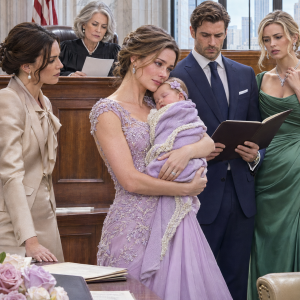
“You’re not required to settle every question today,” she said. “If you both agree, we can put a temporary plan in writing for medical decisions, financial support, and time with the baby after she arrives. The separation can remain in place while you decide what you want to do about the marriage.”
Lila looked down at her hands. Owen waited instead of filling the silence. He had often mistaken silence for a way to avoid conflict. This time, he let it make room for her to think.
After a while, he said, “I spoke to my mother this morning.”
Lila raised her eyes.
“I told her what she said about your work, and I told her what I said after she left. I told her I had failed you by letting her talk to you that way and then making it worse.”
“What did she say?”
“At first, she hung up on me.”
He gave a small, weary smile.
“Then she called back. She cried for a while. I don’t know what that means yet, but I told her she can be part of June’s life when she can apologize to you and mean it.”
Lila studied his face, searching for the familiar reflex to soften his mother’s behavior or ask Lila to let it go for the sake of family peace. She did not see it. That did not erase the past, but it was the first time in months that Owen seemed to understand that loving someone could mean setting a boundary with someone else.
“I want a temporary agreement,” Lila told Ms. Finch. “Medical decisions, support, and visitation after the birth. The divorce stays on hold, but it isn’t canceled.”
Owen exhaled slowly, as though he had been holding his breath throughout the meeting.
“Thank you,” he said.
Lila met his eyes.
“Don’t thank me. Show me.”
Learning to Show Up
Owen began showing up the next morning.
He came to Lila’s follow-up appointment and listened while Dr. Callahan explained what symptoms to watch for and why Lila needed to take it easy. He wrote down the instructions instead of pretending he would remember everything. When the doctor asked whether Lila had questions, Owen did not answer for her.
At the next appointment, he sat beside her and watched the screen as June moved in a blur of gray shapes. Lila glanced toward him once and saw that he was trying not to cry. She did not take his hand, but she did not turn away, either.
Owen helped her prepare for the baby in small, unremarkable ways. He assembled the crib and discovered that the instructions were less clear than he had expected. The first attempt left the frame tilted. He took it apart and tried again, this time following each step carefully while Sadie’s husband checked the joints.
He learned which grocery store carried the lemon sorbet Lila liked and which aisle had the particular brand of crackers she could keep down when her stomach felt unsettled. He took her car in for service and arranged the nursery furniture, asking before he moved anything that belonged to her.
Sometimes he asked too many questions. Sometimes he forgot that his help did not give him a vote in every decision. When that happened, Lila told him plainly. He tried to listen rather than explain why he had meant well.
Their conversations were still careful. They did not pretend that the marriage was repaired simply because Owen had begun to attend appointments. Trust was not a door that swung open again because someone finally turned the handle. Lila had to see what he would do over time, and Owen had to accept that her willingness to let him try did not promise a particular outcome.
One afternoon, while they were choosing paint for the nursery, Owen held up two cards.
“This one?” he asked.
“That’s almost gray.”
He looked at the pale blue sample in his other hand.
“And this one?”
“Too blue.”
He nodded and studied both cards as if the answer mattered as much as any construction plan he had managed at work.
“I’m beginning to understand why you always bring three options home.”
“You’re beginning to understand because you finally asked.”
He took that in without turning it into an argument.
The separation appointment came and went. Lila attended. Owen came too, though he did not ask her to cancel the meeting. They left with an updated temporary agreement and another date on the calendar, neither of them ready to decide what they wanted the rest of their lives to look like.
Three weeks after the hospital visit, on a gray Thursday morning, Lila’s contractions began again. This time they did not stop. Owen was with her, and Sadie met them at the hospital after he called.
Lila held Owen’s hand through the long hours, not because everything between them had been settled, but because she was afraid and he was there. He stayed at her side, followed the nurses’ instructions, and kept his voice calm whenever she looked toward him.
Their daughter arrived three weeks early, small and healthy, with a head of dark hair and a crooked little nose.
When a nurse placed June in Owen’s arms, he looked down at her as if the entire room had narrowed to that one bundle. He supported her carefully and brought her close to his chest.
“Hi, June,” he whispered. “I’m your dad.”
Lila watched from the bed, exhausted and aching, her heart full in a way she did not yet know how to name. Owen’s face was open and tender, but she understood that a beautiful moment could not carry the weight of every ordinary day that would follow. She hoped he would keep showing up after the hospital, when there were no nurses nearby to remind him what to do.
The next morning, Marilyn arrived with a bouquet of white roses. She stood in the doorway for a long moment, holding the flowers against her coat. She looked older than Lila remembered, though it was probably only that her confidence had finally given way to uncertainty.
“Lila,” she said. “I owe you an apology. I’ve been thinking about what I said, and about the way I treated your plans as if they didn’t matter. I was wrong. I’m sorry.”
Lila did not answer immediately. Marilyn’s apology did not erase the evening at the table, but Lila could hear that she had thought about what she was apologizing for.
She nodded toward the chair beside the bed.
“You can sit down.”
Marilyn sat, placed the flowers on the table, and looked at June sleeping in the bassinet. For forty-five minutes, she listened more than she spoke. Lila told her that the shop mattered to her, that the silence at dinner had hurt, and that she would not allow anyone to make June feel like a burden or a bargaining point.
Marilyn nodded. Once or twice she started to explain herself, then stopped and listened instead. When she left, her eyes were red.
It was not a perfect beginning. It was only a beginning.
Clover & Stem
Clover & Stem opened in February, on a bright morning when the snowbanks along the street had begun to shrink but the air still carried winter’s chill. Lila had imagined the first day many times, but the reality was quieter and sweeter than she expected: the bell over the door, the damp scent of fresh greenery, the first customer asking for a small arrangement to take to a neighbor.
Within a month, people were lining up at the counter on Saturday mornings. Some came for wedding flowers, some for a single stem wrapped in brown paper, and some simply because the shop made the block feel more welcoming. Lila learned the names of regular customers and kept a jar of small paper cards beside the register so people could write their own notes.
Owen spent some Saturdays at the shop. He learned how to trim stems without crushing them, how to carry a bucket without bumping it against the doorframe, and how to use the register. He was not naturally graceful around flowers. The first time he tried to tie a ribbon, he made a knot that looked more suitable for securing a package than finishing a bouquet.
Lila laughed, and Owen laughed with her.
June often slept in a carrier against his chest while he worked near the back counter. When she woke, he would pause, wash his hands, and take her into the small office so she could watch the light move across the window. Lila found comfort in seeing him learn the small rhythms of caring for her: checking the blanket, noticing when her expression changed, settling her before her cries grew louder.
Some evenings, after closing, they sat together in the shop while June dozed in her bassinet. They talked about the day, then sometimes about the months that had come before it. Lila did not rush those conversations. Owen did not ask her to skip the parts that made him uncomfortable.
The attorney’s appointment was rescheduled several times. At first, they moved it because of the baby’s arrival and Lila’s recovery. Later, they moved it because neither of them felt ready to make a final decision. Eventually, the date on the calendar stopped carrying the force it once had. They were still separated in the eyes of the agreement, and they still had difficult things to discuss, but the question of what to do next no longer felt like something that had to be answered before morning.
One evening in early spring, Lila finished locking the front door and returned to the workroom. Owen was wiping down the counter while June slept in her bouncer nearby.
“You don’t have to do that,” Lila said.
“I know.” He wrung out the cloth. “I want to.”
She watched him for a moment. He was no longer the man who had looked past her at the dinner table, waiting for a difficult conversation to end. He looked like someone who was trying to notice what was right in front of him.
Lila walked to the shelf above the register and took down the wooden box. She had brought it to the shop weeks earlier, though she had not yet decided what she wanted to do with it. She placed it on the counter between them.
Owen looked at the box, then at her.
“I wrote something else on the card,” she said. “A few weeks ago.”
He opened the lid and lifted the card. Beneath the old note, in fresh ink, she had written a date and one line.
March 20. He showed up. Every single day.
Owen’s hands trembled. He read the words quietly, then looked up at her.
“Lila…”
“I’m not saying everything is fixed,” she said. “I’m saying I’d like to see what happens if we keep trying.”
He did not rush around the counter or pull her into a grand embrace. He reached across the wood and held out his hand.
Lila looked at it before placing hers in his.
She let him hold it.
Beside them, June sighed in her sleep and kicked one small foot. The white knitted booties from the box rested over her toes, soft and a little loose, just as Lila had imagined they would be when she first bought them.
For the first time in a long while, the future did not feel like a decision waiting to be made alone.