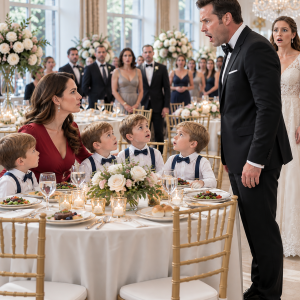
The Message I Sent Before My Son’s Wedding
I did not argue when my only son told me that I would no longer be sitting with the family at his wedding.
I did not raise my voice or demand an explanation.
I simply stood in the bright entrance hall of Rosewood Chapel in Asheville, North Carolina, holding a small navy purse between both hands.
My name is Maren Whitlock, and I was sixty-one years old that morning.
My son, Everett, stood in front of me wearing the charcoal suit I had helped him choose three months earlier. At thirty-three, he had grown into a confident, successful man. He had his father’s broad shoulders, serious brown eyes, and the habit of looking toward the floor whenever he knew he was disappointing someone.
Beside him stood his bride, Sloane Carver.
Sloane wore a silk robe over her wedding dress while the final preparations were being completed. Her golden-brown hair was pinned into an elegant knot, and small diamonds sparkled at her ears.
Everett drew in a slow breath.
“Mom, Sloane and I think it would be better if you sat farther back today.”
For several seconds, I thought I had misunderstood him.
Guests moved around us carrying flower boxes and ivory programs. A photographer adjusted his camera near the staircase. From inside the chapel, a pianist practiced the first notes of the wedding march.
I looked directly at my son.
“Farther back?”
Everett shifted his weight.
“There’s a seat for you in the fourth row. It’s still close to the front.”
The first row had been reserved for immediate family.
I had paid for the flowers decorating that row. I had chosen the pale blue ribbon because Sloane said it matched the wedding colors. I had also covered nearly half the cost of the chapel after Everett quietly admitted that their original budget was not enough.
Yet I was suddenly no longer considered immediate family.
A Seat Away from My Own Son
Sloane placed one hand gently on Everett’s arm.
“Maren, we’re not trying to make you feel unwelcome,” she said. “We just want today to be peaceful.”
She had called me Maren from the first day we met.
Never Mom.
Never Mrs. Whitlock.
Always Maren, spoken with a pleasant smile that somehow made the distance between us feel intentional.
I glanced toward the open chapel doors.
Two white cards marked “Family” rested on the front pews. Sloane’s parents, her sister, and three of her relatives would sit there.
My place had been moved behind several couples I barely knew.
“Was this your decision?” I asked Everett.
He hesitated.
That hesitation told me everything.
“We decided together,” Sloane answered for him. “It will help everyone relax.”
I could have reminded Everett of the nights I stayed beside his bed when he had a fever as a child. I could have mentioned the weekends I spent driving him to baseball practice, the loans I quietly paid when he opened his first office, or the years his father and I worked so he could begin adulthood without heavy financial pressure.
But love should not have to present receipts to prove that it existed.
I nodded once.
“I understand.”
Everett’s shoulders relaxed.
His relief hurt more than the request itself.
I turned before he could see the emotion in my face and walked out through the chapel doors.
The Promise Beside a Hospital Window
The June sunlight was bright outside, and the mountains surrounding Asheville looked almost peaceful.
I sat in my car, placed my purse on the passenger seat, and stared through the windshield.
My husband, Calvin Whitlock, had been gone for almost three years.
Calvin and I had built Whitlock Home Supply from a small neighborhood store into a company with fourteen locations across North Carolina and Tennessee.
We had never lived like people who owned a successful business.
We remained in the same modest brick house where Everett had grown up. Calvin drove an old pickup until repairing it cost more than replacing it. I still used coupons at the grocery store even after our accountant told me I no longer needed to worry about small savings.
The company looked successful from the outside, but its real foundation had been sacrifice.
For years, Calvin opened the first store before sunrise. I handled invoices, customers, payroll, and deliveries while raising Everett. Some evenings, our son slept beneath my desk because we could not afford childcare.
Shortly before Calvin passed away, he asked me to sit beside him near the hospital window.
His voice was weak, but his thoughts were clear.
“Maren, promise me you won’t transfer the company or the family trust to Everett until he understands what it took to create them.”
I squeezed his hand.
“He’s a good man, Calvin.”
“I know he is,” my husband replied. “But good people can still make careless choices when they’re afraid of losing someone.”
I promised him I would protect what we had built until Everett was ready.
At the time, I believed that day would come quickly.
Then Everett met Sloane.
The Questions That Came Too Early
I genuinely wanted to welcome her.
During our first dinner together, Sloane brought white roses and told me how much she admired women who built businesses.
“Everett says you were the heart of the company,” she said warmly.
I thanked her.
Still, something about her compliments felt carefully prepared, as though she had studied what I wanted to hear.
Within two months, her questions changed.
She wanted to know whether Everett would inherit the company immediately after marriage.
She asked whether he would receive voting authority over the stores.
She wondered if our mountain cabin belonged to me personally or to the Whitlock Family Trust.
At first, I told myself she was simply interested in her future.
Young couples talked about finances. Marriage required planning. Perhaps I was being unfair because no one seemed good enough for my only son.
Then, during Sunday dinner, Sloane placed her glass on the table and smiled at me.
“Don’t you think newlyweds should begin their marriage with complete financial independence?”
“Independence from what?” I asked.
“From parents controlling assets that will eventually belong to them anyway.”
Everett stared at his plate.
I waited for him to object.
Instead, he said, “Dad always intended for me to have the business.”
“Your father intended for you to become capable of protecting it,” I replied.
Sloane leaned back.
“That sounds like the same thing.”
“It isn’t.”
The room became quiet.
After that evening, Everett visited less often.
What I Found When I Became Quiet
I never accused Sloane of anything.
I had spent most of my life managing a company. I knew that suspicion was not evidence and emotion was not a business plan.
So I began asking careful questions.
Our attorney, Nadine Holloway, had worked with Calvin for nearly twenty-five years. She was practical, patient, and not easily alarmed.
I asked her to review the family trust and ensure that no one could access it through marriage alone.
I also hired a financial investigator to examine public business records connected to Sloane.
The results arrived in a plain brown folder.
Several years earlier, Sloane had opened an event-planning company with a former friend. The company closed after unpaid debts and disagreements over missing funds.
Two previous partners had filed civil claims against businesses she managed.
She had also been engaged twice before meeting Everett. Both relationships ended shortly after financial agreements were requested.
None of that proved she did not love my son.
But it was enough to make me cautious.
Then Nadine called me three weeks before the wedding.