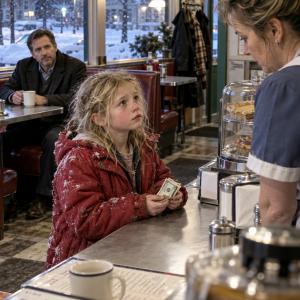
My father stared down at his granddaughter, and slowly his eyes filled.
“Hello, Lily,” he whispered. “I’m Grandpa Will.”
He swallowed.
“I’ve been late to too many important things. I’m going to work very hard not to be late for you.”
What Ethan Finally Saw
Ethan arrived three days later.
He looked exhausted.
We sat in my father’s library while Lily slept beside me.
“I’m sorry,” Ethan began. “Mom said you’d rather stay home, and I thought—”
“Stop blaming your mother.”
He stopped.
I handed him my phone and showed him Diane’s message.
His face changed as he read it.
“I didn’t know she sent this.”
“I believe you.”
He looked relieved.
“But that isn’t the problem.”
The relief disappeared.
“You took the only car with Lily’s seat in it. You left your wife six days after giving birth without transportation. Then you sat at a table where nobody had even planned a chair for us.”
Ethan stared at the floor.
“For years, your mother has called me ‘the librarian’ like it’s something embarrassing. She chose our curtains, criticized my clothes, rearranged my kitchen, and walked into my hospital room acting as if becoming a grandmother gave her authority over becoming a mother. And every time I asked you to stand beside me, you told me, ‘That’s just Mom.’”
My voice softened.
“I never needed Diane to choose me, Ethan. I needed my husband to choose me.”
He covered his face with both hands.
A few minutes later, my father appeared in the doorway.
Ethan stood immediately.
“Mr. Bennett—”
“Sit down, Ethan.”
My father remained standing.
“I’m not going to tell my daughter what to do about her marriage,” he said. “I forfeited the right to lecture anyone about family a long time ago.”
Then he told Ethan about Seattle.
About believing there would always be another day.
About arriving too late.
“Men like us are very good at explaining ourselves,” my father said. “We say work mattered. We say Mom wanted it. We say everybody was tired. We say it was easier this way.”
He glanced toward me.
“Eventually you realize a family doesn’t disappear in one enormous moment. You lose your place in it through small moments when you keep choosing what’s easier.”
Ethan’s eyes were wet.
My father walked toward the door, then stopped.
“Don’t learn that lesson as late as I did.”
And he left us alone.
The Empty Chair

I stayed with my father for three months.
Ethan began therapy without my asking.
He came to see Lily every other day, sometimes driving nearly an hour through Denver traffic just to feed her and sit beside her crib.
He stopped asking when I was coming home.
Instead, he started showing me what home might look like if I ever chose to return.
He set boundaries with his mother.
He learned Lily’s schedule.
He learned how to sterilize bottles, fold tiny sleepers, soothe her at two in the morning, and recognize the difference between her hungry cry and her tired one.
Diane eventually apologized too.
Not beautifully.
Not perfectly.
But truthfully.
“I treated you as though you had to earn a place in my family,” she told me. “And when I discovered who your father was, I suddenly became afraid of losing you. I’ve had to ask myself why your father’s success changed anything for me.”
I appreciated that she didn’t pretend the answer was flattering.
When she visited Lily again, she stood beside the crib and waited.
I lifted my daughter and said, “You can hold her now.”
Diane extended her arms only after I offered.
That small gesture mattered more than any apology.
Ethan and I eventually moved into a smaller house near the elementary school where I worked.
I chose the paint.
He didn’t ask his mother.
Some wounds don’t disappear because someone says sorry. Some trust has to be rebuilt so slowly that you barely notice it returning.
We’re still rebuilding ours.
But every Sunday, something happens that once would have seemed impossible.
My father arrives around nine in the morning.
He drives himself.
The first Sunday, I asked where Walter was.
Dad shrugged.
“Walter spent thirty years showing up for me. I think I can drive myself to my granddaughter’s house.”
He stays all day.
He reads Lily the books my mother once read to me. He makes terrible animal noises. He pushes her stroller around the neighborhood and knows more of our neighbors than I do.
Sometimes Ethan joins him.
The two men aren’t especially comfortable together, but perhaps that is fitting. They are both learning.
One Sunday, months after the night I left, Ethan sketched a silly picture while Lily played in her high chair.
It showed a long dinner table.
There was Ethan, Lily, me, Dad, Walter, Ethan’s sister, and even Diane at the other end.
One chair remained empty.
On its seat, Ethan had drawn a little sprig of lavender.
I stared at it.
“Who’s that for?”
He looked surprised that I needed to ask.
“Your mom.”
My throat tightened.
“If we’re drawing the whole family,” he said, “she should have a place too.”
That night, after everyone left, I found my father standing alone on our back porch.
Lily was asleep against his shoulder.
“Dad?”
“Hmm?”
“Why did you answer so quickly that night?”
He looked confused.
“When I called you. You answered before the second ring.”
He looked down at Lily.
“Because I’d been keeping my phone beside me since the day she was born.”
I felt tears sting my eyes.
“You thought I’d call?”
“No.”
He smiled faintly.
“I hoped you might.”
For years, I believed my father had failed me because he wasn’t there.
I was right.
For years, he believed that failure meant he had lost the right to ever come back.
He was wrong.
That was the lesson neither of us understood until Lily arrived.
Showing up late does not erase the time you missed.
An apology doesn’t rebuild a family.
Money certainly doesn’t.
But sometimes love begins again with something much smaller: a room prepared quietly, a phone answered on the first ring, a grandfather learning how to hold a baby, a husband finally noticing who isn’t sitting at the table.
And sometimes it begins with four words you never expected yourself to say.
“Dad, come get me.”
My father did.
This time, he was early.