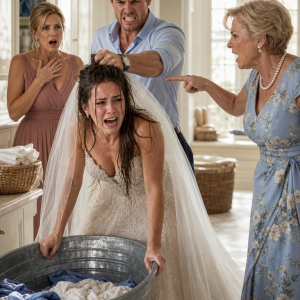
The Night the House Changed Hands

The freezing rain had begun just before sunset, sweeping in from Narragansett Bay and glazing the stone steps of the Aldridge estate with a thin, treacherous shine. By eight o’clock, the bare branches along the drive were bending beneath the wind, while every window of the mansion glowed with the warm amber light of a home that appeared, from the road, to be peaceful and secure.
I stood outside that home with my ten-day-old twin sons pressed against my chest.
My husband, Preston Aldridge, had one hand on the open front door and the other against my shoulder. Behind him stood his mother, Margaret, wrapped in an ivory cashmere coat, and beside them was Rachel Bennett, the woman I had called my closest friend for nearly twelve years.
Rachel was wearing my pale blue robe.
It was a small detail compared with everything else happening, yet it was the detail that made the truth impossible to deny. She had not merely visited the house. She had been inside my bedroom, opened my closet, and chosen something that belonged to me because she had already decided I would never return for it.
Margaret pointed toward the circular drive.
“Take those babies and leave before the neighbors see you.”
Preston pushed the old suitcase he had packed for me with his shoe. The clasp opened when it struck the wet pavement, spilling two blouses, a pair of jeans, and a baby blanket into the rain.
“You heard her, Claire,” he said. “This marriage is finished.”
My son Mason began to fuss beneath the wool covering, disturbed by the sudden movement and the cold air, while Elliot slept against my collarbone, his tiny mouth parted in perfect trust. I tightened my arms around them and looked at the man I had married fourteen months earlier, searching his face for some sign that embarrassment or simple human decency might still reach him.
There was nothing.
Preston had been drinking. I could smell it on his breath, though his white shirt was freshly pressed and his dark hair remained carefully combed. Even then, he cared about appearing controlled.
“They are less than two weeks old,” I told him. “Whatever you think of me, bring them back inside while we talk.”
He gave a small, humorless laugh.
“You don’t get to make requests anymore. You came into this family with nothing, and now you expect to stay because you produced two children.”
Rachel slipped her arm through his. She did it slowly enough to make certain I saw.
“Please don’t turn this into a scene,” she said. “Preston needs someone who can stand beside him in his world. You were never comfortable here, Claire. You were always happier sketching displays or sewing curtains or whatever it is you do.”
For the past year, I had allowed the Aldridges to believe that I earned a modest living designing museum exhibits. That work was real, and I loved it, but it was only one narrow corridor in a much larger building. Before meeting Preston, I had founded Northstar Heritage Holdings, an investment company specializing in restoring historic properties, regional manufacturers, and struggling family businesses. Through carefully structured subsidiaries, Northstar controlled assets worth several billion dollars.
My name rarely appeared publicly. I preferred it that way.
When Preston told me his family’s century-old manufacturing company was close to collapse, I quietly arranged its rescue through one of Northstar’s acquisition firms. I never told him that the company paying his salary belonged to me, partly because I wanted to know whether he loved Claire Whitaker or merely what Claire Whitaker could purchase for him.
I had received my answer.
Margaret lifted her chin, diamonds flashing at her ears.
“The divorce papers will be delivered tomorrow. You will accept the settlement Preston offers, surrender any claim to the estate, and disappear with dignity.”
I looked past her into the marble foyer where family portraits hung beneath crystal lights. She spoke of the estate as though generations of Aldridges had preserved it through discipline and sacrifice, but the property had been facing foreclosure when I purchased it through a trust. The taxes, renovations, staff salaries, and insurance had all been paid from accounts I controlled.
They were ordering me off my own property.
Oddly, realizing that steadied me. The ache did not disappear, but the confusion did. I understood at last that there was nothing left to save inside that doorway.
I shifted the twins carefully, reached into my coat, and removed my phone.
Preston smirked.
“Who are you calling? Another artist friend with a dented station wagon?”
I entered a number known to only four people.
“Daniel,” I said when my chief legal officer answered. “Begin the Aldridge separation plan. Suspend executive access, secure the company records, and deliver the compliance files to the federal review team.”
There was no hesitation.
“Understood, Ms. Whitaker. We are three minutes away.”
I ended the call and met Preston’s eyes.
“Before this goes any further, I want to give you one last opportunity. Are you certain you want me and the boys removed from this house tonight?”
Rachel laughed softly, but Preston’s expression tightened.
“Stop pretending you have leverage.”
Headlights appeared beyond the iron gates.
Four black vehicles entered the drive in orderly formation, moving past the gatehouse without stopping because the security system recognized them as the property owner’s authorized convoy. The vehicles came to rest below the steps, and several attorneys, financial auditors, child-care specialists, and members of my private protection team stepped into the rain.
Daniel Price emerged from the first vehicle. At sixty, with silver hair and the quiet composure of a man who had spent his career handling complicated corporate disputes, he rarely needed to raise his voice. He walked directly to me, placed a dry cashmere wrap around my shoulders, and motioned for a nurse to examine the twins.
Then he turned toward Preston.
“Your access to Aldridge Manufacturing has been suspended. Your company cards, office credentials, and signing authority are no longer active.”
Preston stared at him.
“You work for our board.”
“I represent Northstar Heritage Holdings,” Daniel replied. “Northstar acquired seventy-two percent of your company eleven months ago. Ms. Whitaker is its founder and controlling owner.”
For several seconds, no one spoke. Rain tapped against the stone and ran in silver streams from the roof.
Margaret’s gaze moved from Daniel to me, then toward the house behind her.
“That is absurd,” she said. “Claire arranges exhibits for small museums.”
“I do,” I answered. “I also purchased this estate, refinanced your company, and approved every dollar Preston has received since last spring.”
Rachel released Preston’s arm.
He looked toward the line of vehicles, the attorneys holding sealed folders, and the security officers now positioned along the drive. His confidence began to fade as he recognized the difference between an improvised bluff and an operation that had been prepared for months.
“You deceived me,” he said.
“I protected my identity. You deceived me every morning you kissed me goodbye while planning a future with Rachel.”
Daniel handed Preston a notice confirming that he and Margaret had seven days to remove their belongings under the conditions established by the property trust.
That should have been the end of the evening. It was only the beginning.
The Records Beneath the Marriage
Preston moved down one step, his attention fixed on the folder in Daniel’s hand.
“Claire, listen to me. Whatever Rachel told you, this can be explained.”
Rachel looked at him as if she had never seen him before.
“Don’t involve me in your financial problems.”
Ten minutes earlier, she had stood in my robe and spoken as though she were already mistress of the estate. Now she edged toward the doorway, hoping to detach herself from the consequences before they reached her.
I might have found the transformation almost amusing if Mason had not been trembling against me.
The nurse, Dr. Meredith Shaw, opened the rear door of the nearest vehicle and prepared a warmed infant carrier. Once both boys were safely settled inside, I could breathe deeply for the first time since stepping into the rain.
Daniel opened another folder.
“Preston, the review is not limited to your dismissal. We found unauthorized transfers through consulting firms created under false vendor profiles. Several payments correspond to private purchases, gaming debts, and gifts.”
Preston’s face changed.
The transfers had begun eight months earlier. At first, the sums were small enough to hide among legitimate invoices, but confidence had made him careless. By the time my auditors identified the pattern, he had redirected more than four million dollars from the company’s recovery fund.
I had instructed Daniel not to confront him immediately. We documented every transaction and allowed the review team to follow the accounts independently so no one could later claim that I had manufactured evidence during an unhappy divorce.
“Those were approved business expenses,” Preston insisted.
“Then you will have an opportunity to explain them to the federal investigators arriving tonight,” Daniel said.
A siren sounded beyond the gate, muted by the storm.
Preston’s knees seemed to weaken, and he caught the stone railing.
“Claire, we have children. You cannot do this to their father.”
The words reached me with surprising force. For months, I had suspected that Preston was being unfaithful, yet I had never wanted my sons to grow up surrounded by bitterness. Even after discovering the missing money, I had imagined some carefully managed arrangement in which he might become a responsible parent from a distance.
But Daniel was no longer watching Preston. He was watching me.
Something troubled him.
He removed a plain envelope from inside his coat and held it with both hands.
“There is another matter. The private laboratory completed the comparison you requested.”
During my pregnancy, I had asked Daniel to arrange confidential genetic testing after finding medical forms in Preston’s desk that I did not recognize. I had believed the records might prove he had another child. The possibility had frightened me, but it was still far simpler than what the envelope contained.
I took the report.
The first page stated that Preston had no biological connection to Mason or Elliot.
For a moment, the letters lost their shape. I gripped the edge of the document, trying to reconcile the result with the unchanging truth of my own life. I had never been unfaithful. The twins had been conceived during my marriage after months of carefully monitored fertility treatment at a private clinic selected by Margaret.
Then I noticed the secondary finding.
The boys’ paternal genetic profile was consistent with a close relative of Preston’s, most likely from the generation above him.