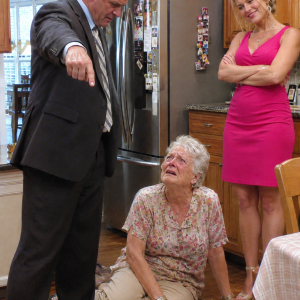
Tessa brought in a mug of tea.
“Have you called Nora?”
Nora Bell was my attorney. She had helped me review the prenuptial agreement and had handled the final paperwork when I bought the house.
“Not yet,” I said.
“Then let’s start there.”
The next morning, Nora arrived at Tessa’s with a laptop, a folder of documents, and the practical calm of someone who had seen people make their worst decisions while assuming there would be no consequences.
I told her what had happened and played the call recording. In Oregon, Nora explained, recording a private conversation could carry legal concerns depending on who knew about it and how it was made, so she would have her office review it before using it. We would preserve the original, keep a written account of the call, and rely first on the property records, the agreement, and the messages Graham had sent.
I had not known that the call was being saved. My phone’s call-recording service had been set up during a previous business dispute, and I had forgotten it was still active. I did not need it to understand what Graham had said, but Nora listened closely.
Then she asked me to open the folder containing the deed and the prenuptial agreement.
The property had been paid for years before my marriage. The title was in my name alone. The agreement specifically identified the house and the value of my separate assets, as well as the terms for any property acquired later. Graham had signed each page.
Nora read the documents in silence, then turned her chair toward me.
“He may believe that marriage gives him a right to make decisions about the house, but the paperwork does not support that belief. We’ll make sure the record is clear, and we’ll handle the separation through the proper channels.”
I asked whether I could simply return home.
“I don’t recommend walking into a house where he has invited guests and changed the security access, especially while you’re caring for a newborn. We can secure your personal belongings and communicate through counsel. I also want to know whether the property is already listed for sale.”
I looked at her.
The truth was, it was.
Before June was born, I had quietly begun discussing a sale with a local real estate firm. The house had become too large for the life I wanted, and I had been drawn to the idea of a smaller home where a child could play in the yard without my worrying about the long driveway or the steep back steps. I had not told Graham because we had not yet made a final decision about where we would live. I wanted the choice to be ours, if it could be.
A buyer had made a cash offer. We had agreed on a closing date for that Friday, and the sale had already passed through the ordinary legal review. Nothing about the buyer or the transaction was arranged as a trap. But the timing, now, meant that Graham’s attempt to claim the house was about to become much more than an argument.
Nora read the purchase agreement and checked the closing schedule.
“The sale can proceed if the title company confirms everything is in order,” she said. “You should not use the sale to provoke him or to stage a confrontation. We’ll notify him and his attorney in writing, and we’ll make sure the buyer receives clear possession according to the contract.”
I nodded. I had not planned to provoke anyone. I wanted my daughter safe, my property protected, and a life that did not depend on someone else’s permission to enter my own front door.
That afternoon, Nora sent Graham’s attorney a formal notice that the house belonged to me as separate property, that no one had permission to use it for a party, and that all further communication about access or belongings should go through the attorneys. She also asked that Graham return the keys and confirm that the house would be left in proper condition for closing.
His response came by email several hours later.
It was short, dismissive, and filled with the same assumption that had guided his phone call: he called the house “our shared residence,” said his family was “entitled to reasonable access,” and claimed I was overreacting to a temporary arrangement.
Nora read the message twice.
“It’s useful that he has put his position in writing,” she said. “We’ll respond with the records and keep the focus on the facts.”
I sat with June in my arms while Nora typed. The baby’s fingers curled around the edge of my shirt. I could smell the clean, milky warmth of her hair, and for the first time since the storm, I felt my breathing slow.
The next morning, I signed the final closing documents.
The Weekend That Changed Everything
By Friday afternoon, the sale had closed. The buyer’s trust had taken ownership under the recorded deed, and the proceeds went to the account established under my premarital trust arrangements. Nora had made sure the transfer followed the agreement and the state’s rules, and the buyer had received written notice about the conflict over access.
I did not celebrate. I did not even feel relief right away. I felt tired, and a little sad, because the house carried years of my life inside it. I had chosen every window and watched the garden fill in. I had expected to leave someday, but not this way, and not with my daughter’s first days at home tangled up in a legal dispute.
Still, I knew the sale was the right decision. The house had become a symbol in Graham’s mind: a thing he could claim because he had married its owner. I wanted no more years of negotiating over the meaning of “ours.”
That evening, Drew arrived with eight friends in a line of SUVs. They had driven in from Portland and Salem, expecting a private weekend at the estate. He walked to the front door, entered the code Graham had sent, and tugged at the handle.
Nothing happened.
He tried again.
A security alarm sounded through the entry and across the grounds, loud enough to make the men step back. Within a few minutes, a security vehicle entered the driveway, followed by two more. The new owners had arranged for a local firm to monitor the property during the transition, and Nora had ensured they had the notice of trespass and the relevant ownership documents.
Two uniformed officers arrived shortly afterward. They were calm, and no one was touched. The group remained outside while the security staff confirmed the situation.
Drew raised both hands.
“Hey, hold on. Graham Vance owns this house. He gave us the code.”
The officer asked for identification and then explained that the property had been transferred that afternoon. The legal owner had requested that no one enter without permission.
“This can’t be right,” Drew said. He pulled out his phone. “I’m calling Graham.”
Graham was at an upscale restaurant in Palm Beach with Lorraine and Paige when his phone began buzzing. He answered with a laugh.
“Hey, Drew. You get in all right?”
Drew’s voice came through loud enough for the people at Graham’s table to hear.
“Graham, what is going on? There are security people here and the police. They say you don’t own the place anymore.”
Graham stood so quickly that his chair scraped against the floor.
“What are you talking about? Use the code I gave you.”
“I did. The door won’t open. They have paperwork showing the house belongs to a trust now.”
Lorraine lowered her fork. “Graham, what’s wrong?”
Before he could answer, an email arrived from Nora’s office. Its subject line referred to the closing and the notice concerning possession. Attached were a certified copy of the recorded deed, a closing statement confirming that the sale had been completed, and a formal notice that the new owner held legal title.
A second attachment was a petition for divorce. It cited the prenuptial agreement, the division of separate property, and the communication concerning my exclusion from the home. Nora had also requested temporary orders about contact and arrangements for June while the case proceeded.
Graham stared at the screen. His wineglass tipped over, spreading across the tablecloth.
“Graham?” Lorraine asked. “What did you do?”
He looked as if he had forgotten there were other people in the room.