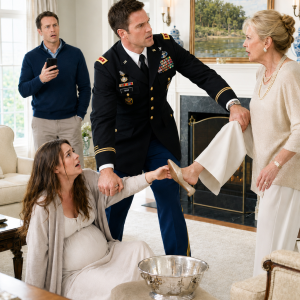
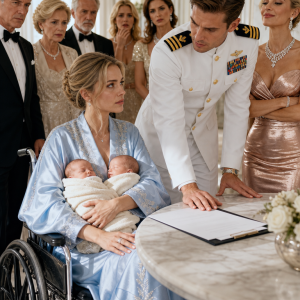
When we returned downstairs, headlights crossed the front windows. A woman in a camel coat stood at the door with one protective hand over her stomach. Beside her was a six-year-old boy with dark hair and Blake’s gray eyes.
The child saw my husband and ran past me.
Daddy!
Blake caught him automatically, with the practiced movement of someone who had done it many times. The boy wrapped his arms around Blake’s neck and said he had missed him.
Mallory stared at me in confusion. You didn’t know about Caleb?
Caleb was six. Blake and I had been married for five years. He had known about the child before our wedding and had told Mallory that I understood their arrangement. He had also told her that once our twins were born, he would control the trust and finally end our marriage.
Samuel’s expression changed. Did you marry Hannah to satisfy the trust conditions?
Blake denied it too quickly, while Mallory shook her head. You told me the babies were the last requirement. You said everything would be released afterward.
Samuel turned several pages in the audit folder and found something even more troubling: six weeks earlier, Blake had asked an insurance adviser to estimate a policy on my life and had questioned whether the trust terms changed if a spouse was no longer present.
Blake insisted it was ordinary planning suggested by an attorney named Victor Sloane. Samuel knew the name. Sloane had once advised Warren Archer before losing his license over missing client funds.
At that moment another preview appeared on Blake’s phone.
Do not let your father find the original amendment. Destroy it tonight.
Blake ran to his study and pulled an old document from a locked drawer. Samuel followed, took it from his shaking hands, and read until his face became pale. The amendment appeared to redirect the largest family share to Caleb, provided he was Blake’s biological son. Blake then admitted that a private test had shown he was not. Victor Sloane was Caleb’s father, and Mallory had known Victor before she knew Blake.
On the final page, beneath a disputed filing date, stood the signature of the witness.
Ruth Caldwell—my mother, whom I had mourned for eleven years.
The Names My Childhood Had Hidden

My mother had been a forensic bookkeeper, and before her disappearance she had reviewed accounts connected to Warren Archer’s company. Samuel remembered her firm, although he had never connected Ruth Caldwell to the daughter-in-law sitting at his table.
Mallory produced an old photograph she had found among Blake’s papers. It showed Warren outside a courthouse with Samuel, Victor, my mother, and my father, Peter Caldwell, who had vanished when I was six. On the back was a warning to keep copies away from Victor.
I had spent most of my childhood believing my father had abandoned us and most of my adulthood believing my mother had been taken from me after a highway accident. Now both stories seemed uncertain.
Samuel suspended Blake’s access to every trust account and ordered him out of the house. Then he took me and the twins to his wooded property outside Dayton. His sister came the next morning to care for the babies while Samuel and I visited Agnes Bell, Warren’s former executive assistant.
Agnes was eighty-two, sharp-eyed, and living less than half an hour away. When she opened the door and saw me, she began to cry.
You have Ruth’s face, she said.
Her living room contained a recent photograph of my mother, visibly older than the woman in my memories. Agnes explained that Ruth was Warren’s daughter from a relationship he had hidden long before his marriage. Years later, regret led him to revise his estate so that Ruth’s branch would receive an equal share. My parents helped document Victor’s effort to alter the family records and divert funds, but my father began moving money too, persuading himself that he could redirect it to families harmed by unethical company contracts.
Victor used that misconduct to control them. My parents tried to disappear, but fear and suspicion divided them. Peter vanished first. Years later, when Ruth learned he was still alive and searching for her, she used confusion following a highway accident to assume another identity. She believed leaving me with my aunt was the only way to keep both men from using me.
Agnes handed me a box containing eleven unsent birthday cards and a letter.
My sweet Hannah, if you ever read this, please know that distance was never the absence of love. I was afraid that anyone who found me would find you. I made a choice meant to protect you, but I know protection can leave its own wounds.
I lowered the page. Love did not cancel abandonment, and a good intention could not restore the birthdays, graduations, and wedding mornings she had missed.
That night, a black sport-utility vehicle stopped outside Samuel’s gate. Victor left an envelope on the stone pillar and drove away. Inside was a photograph taken months earlier, showing both my parents beside a lake, and a set of coordinates leading to an unused municipal airfield two hours away.
His message instructed me to come alone if I wanted answers.
Samuel, who had spent three decades planning for uncertainty, contacted a former federal investigator and local authorities. We went to the airfield with a careful plan, a recording device hidden beneath my coat, and officers positioned beyond the hangars. Blake insisted on coming because he had finally learned that Victor was also his biological father. Samuel had raised him from infancy without knowing the truth.
Victor waited inside a rusted hangar beside a folding table. He looked like an ordinary, prosperous man nearing retirement, which made the reach of his manipulation seem even more unsettling.
Where are my parents? I asked.
Your father is safe, and your mother is close, he replied. But first you should understand why everyone has wanted something from you.
The original trust had not favored Blake or Caleb. It divided Warren’s estate between Samuel’s family and Ruth’s, with a portion reserved for charity. If Ruth became legally unavailable before I turned twenty-five, her share passed directly to me. I had reached that age eight months earlier without knowing that I had become the largest individual beneficiary.
Victor had arranged for Blake and me to meet at an arts fundraiser years earlier. He wanted the two family branches joined through marriage, with Blake serving as the respectable Archer face while Victor controlled him privately. He had encouraged Blake to believe that children would secure his authority and that my love would survive anything once we became parents.
Blake stared at him. You used every weakness I had.
Victor answered without warmth. I offered you what you already wanted—importance without discipline.
A side door opened, and my mother stepped into the hangar. Her hair was gray, her face thinner, but her eyes were mine.
Hannah, she said.
For eleven years I had imagined hearing her voice again. I had never imagined how love and anger could occupy the same breath.
You let me grieve you.
I know.
You left a fourteen-year-old girl to believe she had no parents.
I know, and I will not ask you to forgive me tonight.
She told us Peter had uncovered the original trust records, but Victor had taken those records and moved him to prevent their release. When Victor reached inside his coat, federal officers entered from both sides of the hangar. What he removed was not a weapon but a storage drive filled with altered files, payments, and correspondence. It became the evidence that ended his control.
Before the officers led him away, Victor offered one final accusation: my mother had not disappeared only because of him. She had also been hiding from my father.