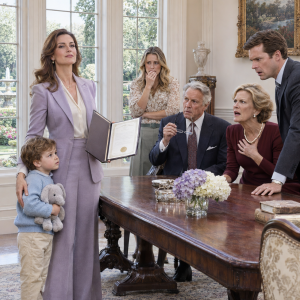
My mother’s face tightened.
“On December third, Mom, you wrote in the family chat that you couldn’t host someone who was broke. Dad, a minute later, you told me to sell my car.”
“Tessa, this isn’t the time,” my mother said.
“It’s exactly the time. You told me not to come because you thought I had nothing left.”
I let the silence settle before I continued.
“I didn’t lose my company. I didn’t sell the vans. I still have my six employees, and the $212,000 in savings is still in my account.”
People looked from me to my parents. My mother reached for the pearls at her neck.
“Then why would you tell us that?”
“Because I heard you talking to Aunt Patricia in October. You said you’d keep using me as long as I kept saying yes, and that I had no family of my own to spend my money on. I wanted to know what would happen if I stopped being useful.”
I looked around the table.
“Now I know. You let me handle it alone.”
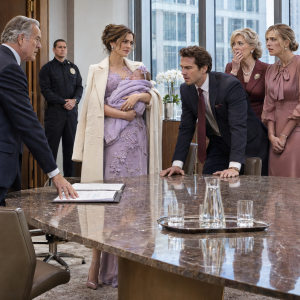
I opened the folder and handed the first pages to Uncle Ray and the next stack to Brent.
“Please pass these around.”
The papers moved from hand to hand. I pointed to the highlighted rows.
“These are forty-eight months of payments. Every month, $1,840 went to the mortgage on this house, and $412 went to Dad’s truck. The total is $108,096.”
Aunt Patricia stared at the pages, then lifted her eyes to my mother.
“Denise, you told me Frank had saved the house himself. You told me he had paid everything off after the store closed.”
Uncle Ray set his pages down.
“Frank, I asked George about that truck last spring. He had no idea what I was talking about.”
My father looked down at the table. For once, he did not seem to have a story ready.
Brent held a page in each hand. His face had gone pale.
“Dad, you knew Tessa was paying the mortgage when you let me borrow $6,300 for my car?”
My mother spoke over him.
“We were going to explain. We were waiting until we had a better sense of what to say.”
“When?” Brent asked. “After you’d taken everything she had?”
He turned toward Maisie, who was sitting very still beside Holly.
“She heard you say Tessa still owed you money, and she walked through the storm in her socks with her savings jar because she thought her aunt was going to lose her home.”
The room fell silent. My mother looked at Maisie, but the little girl lowered her gaze to her hands.
I closed the blue folder.
“I canceled the payments on December fifth. I’m not restarting them. If you need to keep this house, Dad, you’ll have to speak with the bank and make a plan that works for you. If you want to know how I’m doing, you can call me.”
I picked up my coat and walked to the front door. I did not wait to see whether my parents would follow.
A Different Kind of Christmas
Brent, Holly, and Maisie were out the door less than two minutes later. Uncle Ray joined them, muttering that he had eaten enough of his sister-in-law’s cooking for one day.
We drove in separate cars to a diner that stayed open through the holiday. It was bright beneath the neon sign, the coffee was too strong, and the vinyl booth squeaked every time someone shifted. We ordered pancakes. Maisie finished hers and asked for more whipped cream, which I bought without a moment’s hesitation.
It was the best meal I had eaten in years.
The consequences of stopping the payments did not take long to arrive. My parents had to sell the pickup in February. By April, they had sold the four-bedroom house and moved into a smaller condominium near the highway. My father found part-time work stocking shelves at a garden center.
In late May, he came to my shop without calling first. I was repairing a heating unit in one of the service bays when he stood in the doorway, looking at the concrete floor. For several minutes, he said nothing.
Then he mumbled that he was sorry for how things had happened.
It was not a complete apology. He did not talk about the years of payments or admit how much the family story had depended on keeping my help hidden. Still, I accepted his words—not because everything was repaired, but because I did not want to carry the anger with me every day.
My mother did not come to apologize in person. In January, she mailed a card that said, “I should have asked how you were.”
I left it on the kitchen counter for two months before calling her. We now have lunch on the second Tuesday of each month. We talk about ordinary things, and she pays for her own iced tea.
Brent chose to repay the $6,300. I told him he did not have to, but he insisted. Each month, $250 arrives in my account. I transfer the money into a college savings plan for Maisie, and I added $20,000 of my own to start it. I want her to grow up knowing that kindness matters, but so do boundaries, and that love should never require a child—or an adult—to give away every bit of security they have.
Uncle Ray started working part-time at my shop the following January. He answers the early calls from restaurant owners and managers whose heating systems have failed overnight. He says retirement had made him restless. I suspect he also wanted to keep an eye on me, though he has never admitted it.
For a long time, I thought loyalty meant making myself useful enough that no one could do without me. I treated family like a balance sheet: if I gave enough, eventually I would earn a place where I felt safe.
I understand it differently now. Love is not a debt that can be paid down. Sometimes it looks like an eleven-dollar-and-forty-cent jar carried through the snow by a little girl who only wants you to have a warm place to sleep. And sometimes caring for yourself means closing the checkbook, telling the truth, and allowing other people to take responsibility for the lives they have built.