She looked around the building, then back at him.
“They just proved you aren’t.”
I turned to her.
“And you have not been honest either.”
Meredith removed the gray binder.
Grant stared at it.
“What is she talking about?”
Meredith carefully explained that a prior legal proceeding included certified results establishing that Grant had no biological connection to the child.
Natalie’s face lost all color.
“That is private.”
“It will be handled only through lawful channels,” Meredith said. “However, Mr. Holloway has a legitimate reason to understand that the claim upon which he based his decisions was false.”
Grant looked at the little boy, then at Natalie.
“Tell me she’s wrong.”
Natalie said nothing.
“Tell me.”
“Keep your voice down. You’re frightening him.”
“You let me believe he was my son for more than a year.”
Natalie’s jaw tightened.
“Because you desperately wanted to believe it.”
A man named Lucas Bennett then entered with his attorney. Lucas owned several event venues along the North Carolina coast, and his name appeared in the earlier paternity case.
His attorney explained that Natalie had been involved with Lucas, had pursued financial support from him, and then abandoned the claim when his businesses encountered a difficult year. Soon afterward, she began presenting Grant as the child’s father.
At last, the full pattern became clear.
Natalie had not chosen Grant because of some profound love. She had chosen the life she thought he controlled. For years, she had watched him take credit for the condo, the travel, the investments, and the comfort surrounding us. When I became unwell, she saw an opening and assumed she could step directly into my place.
“You said you had millions,” Natalie shouted at Grant. “You said Evelyn owned nothing.”
“I thought that was true.”
“Then you never understood your own life.”
Grant pointed at her.
“You used me.”
Natalie gave a bitter laugh.
“And you used Evelyn for nearly sixteen years. Don’t pretend you’re the injured party.”
It was the first completely honest exchange I had heard between them.
What Grant Had Really Lost
Owen allowed the silence to settle before handing Grant a sealed letter.
“There is another matter. You are suspended from your position while the company completes its separation process. Our audit identified unauthorized expense activity, modified records, and irregularities connected to the financing proposal. The matter has been referred to the appropriate authorities.”
Grant gripped the envelope without opening it.
The investigation had not begun because of me. The accounting department had noticed inconsistencies weeks earlier. His attempt to claim an interest in my building had simply connected several pieces that were already being examined.
For the first time since entering my hospital room, Grant looked directly at me without contempt.
“Evelyn, help me.”
I remained silent.
“Please. Tell Owen this is a misunderstanding. Tell Meredith to fix it. Natalie means nothing to me. The child isn’t even mine. You and I had almost sixteen years together.”
“A week ago, you asked me to sign those papers because you thought I might not wake up.”
“I wasn’t thinking clearly.”
“You called me defective.”
“I was angry.”
“You threw my parents’ belongings into a trash box.”
He lowered his head.
“I’m sorry.”
“I hope one day you understand why you should be. But forgiveness does not mean giving you access to my life again.”
Linda began to cry.
“Evelyn, think about us. We’ll lose the workshop.”
“You never called me your daughter when you believed I had nothing to offer except money you thought came from Grant. Your loans are your responsibility now.”
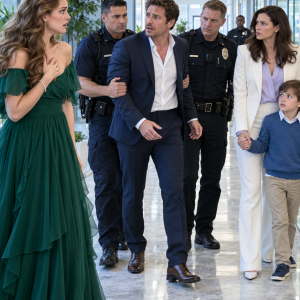
Natalie began moving toward the exit while Grant’s parents argued with their son about the workshop debts. Lucas’s attorney attempted to speak with Natalie about financial matters still awaiting resolution. Within minutes, the people who had planned to celebrate their new family were accusing one another of deception.
Only the little boy remained innocent.
I asked a staff member from the company’s family services office to take him to a quiet conference room with toys and snacks until the adults settled what would happen next. He deserved protection from a conflict he had never created.
A short time later, two investigators arrived regarding the financial case. They did not come because Grant had betrayed his wife. They came because the company had documented conduct involving altered records and property representations.
As they escorted him into a private office for formal processing, Grant panicked.
“Evelyn, I’m still your husband. Do something.”
Meredith answered before I could.
“You were in quite a hurry to change that.”
Grant looked at me, and I saw the moment he finally understood the scale of what he had thrown away.
The cards had never been his. The condominium had never been his. The building had never been his. The child was not biologically connected to him, and the authority he displayed at work had never been as secure as he imagined.
Yet even then, I knew his greatest loss was not financial.
He had lost the one person who had spent years protecting him from the consequences of his own vanity.
The Life I Chose to Keep

The divorce was completed several months later.
My separate assets remained mine, while Grant dealt independently with the employment proceeding and financial investigation. I did not follow every hearing or ask Meredith for constant updates. Recovery, I decided, could not mean spending the rest of my life staring backward at another person’s collapse.
Howard and Linda sold much of the equipment they had recently purchased and negotiated new terms with their lender. I never resumed the deposits.
Natalie disappeared from my circle. Her relationship with Grant ended the day the paternity results became known. Lucas addressed his responsibilities to the child through the legal system, which was the only outcome from that tangled situation that brought me any peace.
The little boy, at least, would not be left unsupported because of the choices made by adults.
I returned to the Charlotte condominium after leaving the medical center. I did not go back to prove ownership. I went because the home still contained pieces of my life that Grant had treated as disposable.
I recovered my parents’ albums from the cardboard box. My mother’s recipe book had been bent but remained intact. A clockmaker restored my father’s brass railway watch, polishing the case while leaving the small scratches he had made through years of honest work.
I sold several pieces of furniture and nearly everything Grant had chosen for the rooms. In their place, I brought in warm lamps, comfortable chairs, and shelves sturdy enough to hold all my books. The condo became quieter, simpler, and more recognizably mine.
Six months after the operation, I visited the memorial garden.
Reverend Keller told me that Grant and Natalie had indeed arrived that weekend with the child, intending to stage their introduction beside my parents’ marker. As promised, he had refused to let them use the grounds for a public display.
I thanked him and walked alone to where my parents rested.
For the first time since the morning of my procedure, I allowed myself to weep.
I did not weep for Grant.
I wept for the woman I had been during nearly sixteen years of marriage—the woman who confused love with protecting another person’s ego, who quietly covered debts and indulged vanity, and who endured cruel remarks because she believed generosity could keep a household together.
My father used to tell me, “Helping someone does not require handing over the keys to your dignity.”
I had understood the sentence intellectually when I was young, but it took years of experience before I understood it in my heart.
Grant had mistaken my silence for dependence. Natalie had mistaken my illness for an opportunity. His parents had mistaken my patience for an obligation.
All of them had confused kindness with weakness.
The harder truth was that, for far too long, I had made the same mistake.
I touched my fingers to my parents’ stone and breathed in the cool autumn air. Beneath my hair, the healing line on my scalp was still visible. I no longer tried to hide it.
It reminded me that I had come through two difficult procedures that year. One removed something dangerous from my head. The other removed a life built upon secrecy, pride, and borrowed appearances.
People sometimes believe that losing a false family leaves a person entirely alone.
For me, it did the opposite.
Once the noise was gone, I found the woman I had neglected while caring for everyone else. She was older and more cautious than she had once been, but she was still capable of hope. She still loved deeply. She simply understood now that love without respect becomes a debt no generous heart can pay forever.
As I left the memorial garden, I placed my father’s restored watch inside my coat pocket. Its steady ticking followed me down the path, not counting the years I had lost, but marking the time that was finally mine.