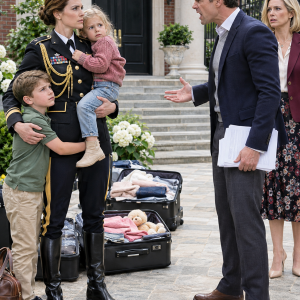
Andrew lowered his hand, visibly uncomfortable.
“Of course, sir. Please forgive me. I had absolutely no idea that Mrs. Bennett was Natalie’s sister.”
My father hurried toward us, his expression caught somewhere between irritation and disbelief.
“Andrew, what exactly are you doing?”
Andrew turned toward him.
“Robert, this is Major General Matthew Bennett.”
My father gave an uncertain laugh.
“Yes, I know his name. He’s married to Rebecca. But you’ve obviously confused him with somebody else.”
“I haven’t confused him with anyone.”
Natalie looked from Andrew to Matthew, then back toward her husband.
“You can’t possibly be serious. Rebecca told us he worked in military transportation.”
Matthew answered before Andrew could.
“That is broadly accurate, although my responsibilities extend considerably beyond transportation.”
Andrew swallowed before continuing.
“General Bennett directs a joint military procurement oversight office. His department reviews major defense supply agreements, including the contracts your company has been pursuing.”
I felt as though the room had shifted around me.
My husband was not simply a military employee recovering from an unfortunate assignment. He was a senior officer whose responsibilities extended into the very government operations my father had spent years trying to influence.
One of my father’s prospective investors, a silver-haired businessman named Charles Whitaker, stepped closer.
“General Bennett? I’ve heard your name mentioned at several federal procurement conferences. I understood that your work was largely confidential.”
Matthew nodded politely.
“Much of it is, Mr. Whitaker.”
My mother’s face had grown unusually pale.
“Rebecca, why didn’t you tell us? Why have you been living in that little rental house and driving that old car if your husband is such an important man?”
Her question bothered me more than I could explain.
She seemed incapable of understanding that Matthew and I had never measured our happiness by the size of our house or the price of our belongings.
Before I could answer, my father began speaking again.
“Well, Matthew, if this is true, there’s clearly been a misunderstanding. You should have explained your position to us years ago.”
Matthew regarded him thoughtfully.
“Would that have changed the way you welcomed my wife and daughter this evening?”
My father opened his mouth, but no answer came.
“Would Rebecca have been given a proper seat if you had known my rank? Would you have offered to help me through the entrance? Would Patricia have welcomed her granddaughter instead of referring to her as another responsibility?”
My mother lowered her eyes.
I had spent years wishing someone would defend me against my family’s dismissive remarks, but hearing Matthew speak so calmly and directly made me realize how accustomed I had become to accepting treatment I would never have tolerated toward someone I loved.
Matthew reached inside his jacket and withdrew a dark leather document case, which he placed carefully on our small table.
“There is another matter we need to discuss, Robert, and I believe several of your guests have a legitimate interest in hearing about it.”
My father’s expression changed.
“What matter?”
Matthew opened the case.
“The federal review of Caldwell Transport Systems.”
The Price of an Impressive Life
For as long as I could remember, my father had spoken about his company as though it were the finest accomplishment any member of our family could ever hope to achieve.
He frequently reminded us that his success had paid for our education, our vacations, and the beautiful home in which we had grown up, and he expected our gratitude to take the form of unquestioning loyalty.
What I had never considered was whether the fortune he was so proud of had been accumulated honestly.
Matthew removed several documents from the case and placed them in front of him.
“Over the past four years, your company submitted invoices for storage facilities that were never operational, transportation services that were never completed, and equipment that failed to meet contractual standards.”
My father shook his head.
“That’s ridiculous. Every one of our accounts has been independently reviewed.”
“Several of those reviews were compromised by an official who had an undisclosed financial arrangement with your company. He provided investigators with a detailed statement earlier today, along with banking records and copies of the original invoices.”
Charles Whitaker quietly set his drink on a nearby table.
My father glanced toward him before returning his attention to Matthew.
“These are accounting disagreements. Businesses deal with them all the time.”
“These are not ordinary accounting discrepancies, Robert. The financial records show a deliberate pattern involving millions of dollars in public funds.”
Matthew explained that my father had used the artificially inflated value of his government agreements to obtain approximately twelve million dollars in private financing, much of which had supported the extravagant lifestyle my parents and Natalie enjoyed.
The vehicles, jewelry, elaborate vacations, and even substantial improvements to the estate had been financed through arrangements that were now under formal investigation.
My mother sat down heavily in the nearest chair.
“Robert, please tell me there’s an explanation for this.”
For the first time in my life, my father seemed unable to find the right words.
Matthew continued, explaining that the company’s accounts had been restricted several weeks earlier, that the resulting missed payments had placed numerous assets in default, and that the lender had transferred certain outstanding debts to a private investment company.
“The investment company that acquired those obligations belongs to a family trust established long before Rebecca and I were married,” Matthew said. “The acquisition was handled independently, with the required disclosures and legal approvals.”
My father stared at him.
“You’re telling me that you control the debt attached to my property?”
“Among other obligations, yes. The remaining assets will be handled through the court-supervised recovery process.”
My mother pressed a trembling hand against her necklace.
“But how could you possibly arrange all of this? You’ve spent the past year sitting in a wheelchair.”
Matthew looked at her for a moment, and then he did something that I will remember for the rest of my life.
He moved the blanket aside, adjusted the wheelchair’s footrests, and placed both feet firmly on the floor.
With his hands resting on the armrests, he rose slowly and steadily until he was standing beside me.
I instinctively reached toward him, afraid that he might lose his balance, but he remained upright without assistance.
“Matthew?”
My voice was barely audible.
He turned toward me, and the seriousness in his expression gave way to unmistakable tenderness.
“My rehabilitation has been going better than I was able to tell you. I’ve been walking independently for several months.”
Tears immediately filled my eyes.
For fourteen months, I had hoped and prayed that he would regain his mobility, and now, standing in front of me, was the man I had imagined taking our daughter to the park, carrying her upstairs at bedtime, and teaching her how to ride a bicycle someday.
Yet beneath my happiness was another feeling I couldn’t ignore.
“Why didn’t you tell me?”
Matthew took my hand.
“My medical recovery was connected to the circumstances surrounding the investigation, and there were restrictions on what I could disclose. Maintaining my existing public status allowed the investigators to complete their work without drawing unnecessary attention.”
He paused before adding, more quietly, “But I know that doesn’t make the secrecy easy for you to accept. You deserved more openness than I was able to give you, and I’m sorry.”
I held his hand tightly, knowing that we would have much to discuss when we were alone.
Natalie suddenly stepped forward.
“So you deliberately let us believe you were struggling? You came here pretending you couldn’t walk just to make everyone look foolish?”
Matthew turned toward her.
“Nobody asked your mother to speak disrespectfully about my daughter. Nobody instructed your father to put us beside the kitchen. Those were decisions they made themselves.”
He looked around the room before continuing.
“And none of you needed to know my rank to understand that Rebecca and Sophie deserved ordinary kindness.”
My father backed away, apparently overwhelmed by everything he had heard, and caught his foot against the edge of the decorative rug beneath the Christmas tree.
He stumbled into its lower branches, sending several ornaments tumbling onto the floor as the tree tilted sideways against the wall.
A server rushed forward to steady it, while my father stood amid the scattered decorations, looking suddenly older than I had ever seen him.
The beautiful celebration he had arranged to demonstrate his importance was coming apart around him.
When the Guests Stopped Smiling
My aunt Margaret was the first relative to approach us after Matthew’s revelations, and her expression had undergone a remarkable transformation.
“Rebecca, darling, why didn’t you come and sit with us earlier? We would have been delighted to have you at our table.”
I looked at her, remembering the remarks she had made when we arrived.
“You knew where we were sitting, Aunt Margaret. You could have joined us at any time.”
She began offering an explanation, but before she could finish, the front doors opened and four people entered the reception hall.