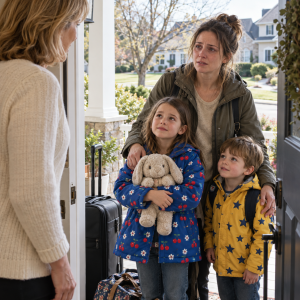
“Letting yourselves in and handing out keys without asking isn’t helping me.”
The second officer explained that someone had submitted residency forms claiming Owen and Marissa already lived at my new address. The forms included my name and a signature that looked almost like mine, though the last letter leaned in a direction I never used.
When the officer asked who had prepared the paperwork, Owen said Paige had assured him everything was legitimate. I remembered the recording of Paige handing my mother the keys and called her, putting the conversation on speaker.
At first, Paige sounded confused. She said Mom had told her I wanted the family to celebrate the purchase, and she had assumed that passing over the spare keys was harmless.
“Why did you give them my keys when I never authorized it?” I asked.
The silence that followed was long enough to tell me what her explanation would not.
“I should have called you directly,” Paige finally said. “I’m sorry. I’ll cooperate with the officers.”
They asked my family to leave while they documented what had happened. Mom kept saying no one meant to upset me. Owen lingered near the doorway as if he expected me to soften, but I did not. When the cars had finally pulled away, the house was quiet except for the lake water moving against the shore.
One officer returned from speaking with Owen and asked me to check my email. An unfamiliar account had sent a scanned document shortly before sunrise, with the subject line PROPERTY TRANSFER AUTHORIZATION. It claimed that I had agreed to give Owen part ownership of the house as a gift to the family.
My name appeared at the bottom beside a signature that resembled mine.
I had never signed it.
I forwarded the message to the officer, then checked the records connected to my purchase. No ownership had changed, but the document included details that should have been available only to people involved in the closing process. By evening, a locksmith had changed every exterior lock, the security company had preserved its recordings, and my attorney, Laura Bennett, had reviewed the paperwork.
She told me the suspected forgery needed to be formally reported. She also noticed that the transfer document appeared to have been prepared several days before the closing.
The Name in the Envelope
The next morning, Paige called again. Her voice was unsteady as she admitted that Mom had contacted her weeks earlier, asking whether Owen could be added to the property records. Paige had refused, but Mom insisted that I had promised to share the house one day.
“I believed her,” Paige said. “I was wrong, and I know I should have verified it with you.”
Before I could ask what else she knew, Laura received a message from an unknown number. It contained a photograph of a loan application listing my house as collateral, with Owen’s name beside mine and an appointment scheduled for the following week.
Someone had not simply planned to bring my family into the house. Someone had prepared to use it to secure money.
My phone buzzed again.
OWEN: Please don’t show Mom this. You don’t understand what she promised them.
I called him, but he did not answer. Seconds later, the doorbell camera alerted me to a visitor at the gate. Paige stood outside holding a thick cream envelope, glancing toward the road as if she expected someone to follow her.
I opened the gate remotely. She walked up to the porch but did not step inside.
“Your mother wasn’t the one who started this,” she said quietly. “You need to see who signed the original agreement.”
Paige handed me the envelope. On its front, in my father’s careful handwriting, were the words: For my daughter.
Inside was an agreement with North Ridge Capital, a private lending firm. It was dated nearly a month before my closing and described a plan to secure a loan against a property I had not yet purchased. Howard’s name appeared beneath the agreement as the person who had arranged the introduction. The document did not give him authority over my house, but it showed that he had connected Owen to the lender and had represented that I would agree to share the property.
Behind it were printed messages between Dad and a loan broker. One message said the family gathering would make the arrangement look settled before anyone asked questions. Another referred to Owen’s overdue business loans and to the house as the simplest way to obtain more time.
The transfer form with my false signature had been added later, but the plan had begun with my father.
For a long moment I stood in the entryway, listening to the refrigerator hum and the lake wind brush against the windows, while the picture I had carried of my father—the quiet man who stayed out of arguments—gave way to a different one, a man who had mistaken silence for agreement and my independence for an opportunity.
I took photographs of every page and sent them to Laura. She forwarded the documents to the officer handling the report and advised me not to contact the lender or sign anything until she had spoken with them.
That afternoon, Howard called.
“You have the wrong idea,” he said. “It was only an arrangement to help Owen. We thought you’d understand once you heard the whole story.”
“You signed an agreement about a house I hadn’t even bought yet,” I replied. “You used my name and planned to use my home as collateral.”
He began to explain that Owen had debts, that his children needed stability, and that our family had always shared what it had. I listened until he ran out of reasons, then told him that sharing required consent, and no one had asked for mine.
“You could have helped your brother without taking my choices away,” I said. “You decided my answer for me.”
He did not deny it.
Owen eventually called Laura and agreed to meet with the officers. He admitted that his business had fallen behind on payments and that Dad had introduced him to the lender. He said he had believed I would accept the arrangement once the family was already gathered in the house, because it would be harder for me to refuse them all at once.
That was the part I understood most clearly: they had counted on my discomfort, on the old habit of keeping peace by giving way.
What Belonged to Me

With Laura’s help, I sent written notice to the lender that I had not signed the transfer or loan paperwork and did not consent to any claim against my property. The lender paused the application while its records were reviewed. The officers kept the camera footage, the emails, and the original agreement, and Paige provided a statement about how she had passed along the keys.
The investigation took time, but the house remained in my name. The false transfer was never recorded, and the proposed loan did not go forward. Owen had to work out his business debts with his creditors, while Howard and Mom had to answer questions about the documents they had helped prepare. Paige lost my trust as an agent, though she cooperated and admitted where she had failed.
For several weeks, I did not speak with my parents. Owen sent me a long message explaining how ashamed he felt, though even then he wrote that he had thought I would understand. I told him that understanding why he wanted something did not mean I had to give it to him.
The first night I slept in the house, the rooms were still mostly empty. I made coffee in a saucepan because my kettle was packed somewhere in the moving truck, carried a chair onto the porch, and sat facing the lake as the last light faded from the hills.
The quiet did not feel like a punishment. It felt like something I had finally earned.
Months later, Owen and I met at a small café near the courthouse. He apologized without asking for the keys or making another argument about what I could afford.
“I treated your work like it belonged to the whole family,” he said. “I know now that it didn’t.”
I accepted his apology, though trust, I told him, would have to grow back slowly. Mom called a few weeks later and said she was sorry for speaking as if my boundaries were a performance. Dad wrote me a letter that was shorter than I expected and more honest than I thought he could manage; he admitted that he had believed helping Owen justified deciding what I would do.
Forgiveness did not require me to hand them another set of keys. It only meant I could stop carrying the argument into every quiet room.
That summer, I planted lavender beside the porch and replaced the kitchen cabinets with simple white ones, leaving the maple and the view just as they were. I invited my parents for coffee one afternoon, but I set the date, chose the time, and made it clear that they would come as guests.
When my mother arrived, she paused on the porch and waited for me to open the door.
It was a small thing, almost ordinary, but I noticed it.
Inside, the keys rested on a hook beside the entryway, where I could see them from the kitchen. They belonged to me, along with the house, the lake view, and the right to decide who crossed the threshold.
For the first time, my family understood that loving one another did not mean claiming one another’s choices. And when I sat on the porch at the end of the day, watching the light settle over Juniper Lake, the quiet felt like home.