“You could say it wasn’t my fault.”
“It wasn’t your fault. You still should have answered.”
He appreciated her honesty. Regret did not need to become blame, but neither did love require pretending nothing had hurt.
Vivian gave a sworn statement about the pressure she had put on Natalie and the choices she had made to protect Peter’s future. She stepped away from the charitable boards she had once led and arranged for part of her estate to support Rebecca’s surviving relatives and Willa’s education. It did not undo the past. It was, at least, a beginning.
Peter separated from his fiancée and told Mara he would not seek custody. He asked for whatever contact Willa could manage. Mara watched him carefully before agreeing to let him send letters.
Conrad began visiting Mara and Willa without bringing his security team upstairs. Graham disapproved.
“This is how poor decisions begin,” he said.
“I’m visiting my niece.”
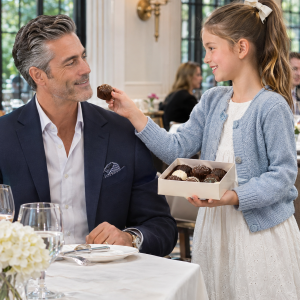
“You brought twenty-four cookies.”
“Children eat.”
“There’s one child.”
“Go away, Graham.”
Willa heard Conrad call himself her uncle and began using the word herself. The first time she said it, he stood in the doorway with a box of cookies and forgot what he had come to say.
One rainy afternoon, she sat beside him coloring stars. The bracelet was on the table because its clasp had begun to loosen.
“Can you fix it?” she asked.
Conrad ran his thumb over the chipped point.
“No.”
“Why not?”
“My sister liked it that way.”
Willa frowned at the bracelet. “But it’s broken.”
“Not everything imperfect needs fixing.”
She looked at him. “That’s a grown-up answer.”
“Probably.”
“Grown-up answers are annoying.”
“I’ve heard that.”
At Christmas, Conrad invited everyone to the family home: Mara, Willa, Beatrice, Natalie, Peter, and Vivian. Beatrice was surprised that he had included their aunt.
“Why invite her?” she asked him in the kitchen.
“Willa asked.”
“Does Willa know what Vivian did?”
“No. She said Vivian looked lonely.”
Beatrice looked toward the living room and sighed. “Of course she did.”
Vivian arrived with a small wooden box, not an expensive gift. Inside were photographs: Natalie as a baby, Peter as a boy, and Beatrice at sixteen wearing the silver star.
Willa held up the last photograph. “That’s Bella!”
Beatrice smiled. “That was me.”
“Do you want the bracelet back?”
The room grew quiet. Beatrice knelt beside her.
“No. I gave it away a long time ago.”
“Why?”
Beatrice considered the question. “Sometimes things pass through different hands before they reach the person who needs them.”
Willa looked at the star, then at Mara. “Like me?”
Natalie covered her mouth. Mara’s eyes filled.
“Exactly like you,” Beatrice said.
Later, when the family had settled around the table, Conrad found his sister beside the fireplace. She told him she might go to Montreal for a while.
He felt his old instinct rise: ask how long, demand a promise, find a reason to keep her close. He let it pass.
“Will you call?”
“Yes.”
“Actually call?”
“Yes.”
“And no more disappearing without a note?”
“That joke is going to get old.”
“It isn’t.”
She laughed, and he hugged her.
A year after Willa first walked into the bakery with twenty-six cents, Mrs. Russo framed the coins and hung them behind the counter. Beneath them she placed a small card: The day Willa came in for broken cookies.
Conrad called it sentimental. Mrs. Russo ignored him, and Willa loved it.
Most Tuesdays, when he was in town, Conrad stopped by for coffee. Willa sometimes joined him before school, still wearing the silver star. One morning she arrived in the pink coat from the rainy day, though it was now too short in the sleeves.
“You need a new coat,” he said.
“I like this one.”
“I can buy you twenty.”
“I only need one.”
His fortune had met its match.
Willa sat across from him and took one of his almond cookies.
“Uncle Conrad, were you scary before I met you?”
He nearly spilled his coffee. Mrs. Russo turned away from the counter, laughing quietly.
“Who told you that?”
“Everybody.”
He looked at the ceiling. “Wonderful.”
Willa leaned closer. “Are you still scary?”
He thought about it. “Sometimes.”
“To me?”
“No.”
“Good.”
She took another bite, and Conrad looked at the girl assembled from so many people’s choices, yet belonging entirely to herself. For years, he had thought the family’s greatest sorrow was losing Beatrice. He understood now that the deeper hurt had come from people mistaking silence for protection.
His father had hidden the truth to keep Beatrice safe. Beatrice had vanished to protect Natalie. Mara had kept her promises to protect Willa. Natalie had stayed away because she believed her absence was safer than her return. Vivian had tried to control the story because she feared scandal. Conrad had made himself intimidating because he believed fear could keep loss away.
Each of them had called it protection. Each silence had cost someone time they could not recover.
Willa finished the cookie and glanced at him. “You ate the whole thing.”
“I was hungry.”
“You have your own.”
“Yours tasted better.”
She gave him Beatrice’s smile.
Outside, rain tapped softly against the bakery windows. Conrad looked at the silver star on Willa’s wrist. Its chipped point caught the light, just as it had the morning she first came through the door.
He had once believed it was proof that his sister had returned from the past. Instead, the bracelet had brought the living back to one another.
Willa reached across the table. “Uncle Conrad?”
“Yes?”
“When I’m big, can I drink coffee?”
“No.”
“That’s not a reason.”
“It is in this family.”
Beatrice’s voice came from behind him. “No, it isn’t.”
Conrad turned. His sister had come back from Montreal early, and Willa leapt from her chair to greet her. Beatrice caught her in both arms.
For years, Conrad had thought strength meant carrying pain without speaking. Now he understood it could mean answering the call, telling the truth before fear turned it into a secret, or returning when you said you would.
Sometimes it was smaller still: a six-year-old girl walking through the rain with twenty-six cents because she loved her mother enough to ask a stranger for broken cookies.
Willa still wore the silver star. Still chipped. Still imperfect. Still exactly where it belonged.