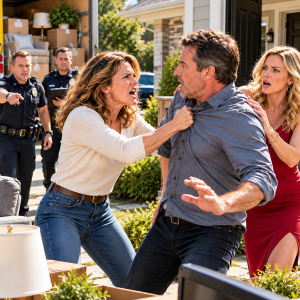
For the first time that night, Liam spoke directly to his wife.
“Harper, stop.”
She stared at him.
“Excuse me?”
“Mom told us to move out in January. We agreed. And we kept acting like she’d change her mind.”
“So now you’re taking her side?”
“I’m saying we were wrong.”
Harper looked from him to me.
“Fine. We’ll leave. And don’t expect me to forget this.”
She marched upstairs.
Liam remained at the table.
After a long silence, he said quietly, “Dad would be disappointed.”
I felt those words more deeply than anything Harper had shouted.
“Yes,” I answered. “I think he would.”
Liam looked up, surprised.
I continued.
“He’d be disappointed that his son was making plans for his mother’s house instead of building a life of his own.”
His eyes filled.
“Mom, I didn’t want you gone.”
“Then why were you talking about what you’d do when I was?”
He covered his face with both hands.
I wanted to comfort him. I wanted to tell him everything would be all right and offer to help with an apartment deposit.
Instead, I stayed in my chair.
Eventually, he whispered, “I’m sorry.”
“I hope you mean that, Liam.”
The Apology That Didn’t Change the Deadline
January was uncomfortable.
Harper barely spoke to me. Liam spent evenings looking at apartment listings, comparing deposits and commuting distances.
Twice, I overheard them arguing about money.
I didn’t interfere.
On January ninth, Liam knocked on my bedroom door.
“Mom, can we talk?”
I set aside my book.
“Of course.”
He sat beside the window.
“We found a two-bedroom apartment. It’s not fancy, but it’s close to work.”
“That sounds promising.”
“The deposit’s more than we expected.”
I waited.
He looked down at his hands.
“But we can afford it. We just won’t have much left over for furniture.”
“Secondhand furniture worked for your father and me.”
He smiled faintly.
“I remember that old green couch.”
“Your father hated that couch.”
“He used to fall asleep on it every Sunday.”
We both laughed.
Then Liam grew serious.
“I’ve been thinking about what you said on New Year’s Eve. I kept telling myself I was trying to keep everybody happy, but I was really letting Harper make decisions I knew you wouldn’t like.”
I listened.
“And I did think about inheriting the house,” he admitted. “Not because I wanted anything to happen to you. It just seemed like we had this safety net waiting for us.”
“I understand that.”
“But it wasn’t ours to count on.”
I nodded.
He took a breath.
“I’m sorry, Mom. For the furniture, the dinners, and for not standing up for you when I should have.”
This time, he didn’t ask me for anything.
That made all the difference.
Harper came to me two weeks later while I was making vegetable soup.
“Chelsea, can I say something?”
I turned down the stove.
“Go ahead.”
She sat at the kitchen island, twisting her wedding ring.
“My mother thinks I owe you an apology.”
I raised an eyebrow.
“Does she?”
Harper gave an embarrassed little laugh.
“I know. That’s not exactly the best way to start.”
Then she looked at me.
“I shouldn’t have called this our house. And I shouldn’t have moved your furniture or invited people without asking.”
I waited.
“When I was growing up, we moved constantly,” she continued. “Apartments, rental houses, whatever my parents could afford. Every time I got comfortable, we had to pack again.”
She looked toward the dining room.
“When Liam and I moved here, it was the first time I’d lived somewhere that felt permanent. I started imagining what our life could be like, and somewhere along the way, I stopped remembering that it wasn’t mine.”
Her voice shook.
“I never wanted anything bad to happen to you, Chelsea.”
“I believe you.”
She looked relieved.
“But that doesn’t change what you said,” I added. “You were making plans around a future where I wasn’t here to object.”
She lowered her eyes.
“I know.”
“And when I told you something hurt me, you treated me like I was being unreasonable.”
“I’m sorry.”
I turned off the stove.
“Thank you for saying that.”
“Do you think you can forgive me?”
I considered her carefully.
“I think so. But I need time before I can trust you the way I used to.”
She nodded.
“That’s fair.”
They moved out on January twenty-ninth.
Liam loaded the last boxes into a rented truck while Harper carried out a small lamp and two suitcases.
Before leaving, she approached me in the driveway.
“Thank you for letting us stay.”
“You’re welcome.”
She hesitated.
“And I’m sorry I made it so difficult.”
I gave her a brief hug.
Liam embraced me next.
“I’ll call you tomorrow, Mom.”
“You don’t have to.”
“I want to.”
I watched them drive away.
Then I went inside, closed the front door, and stood in the quiet hallway.
I cried for several minutes.
Afterward, I made myself a cup of coffee and sat in David’s recliner.
The house was quiet again.
But this time, the quiet didn’t feel quite so lonely.
A Different Kind of Family Dinner
Over the following months, Liam began calling just to talk.
He told me about work, asked how my garden was doing, and occasionally complained about the cost of groceries. When his car needed repairs, he arranged them himself.
Harper changed too.
She called before visiting and stopped assuming I was available whenever she wanted something.
In May, they invited me to dinner at their apartment.
It was small, with mismatched chairs, inexpensive curtains, and a dining table that wobbled slightly when somebody leaned on it.
Harper had made roasted chicken and potatoes.
The chicken was a little dry, and the potatoes had far too much garlic.
I ate every bite.
Afterward, I reached for my plate.
Harper gently stopped me.
“No, Chelsea. You’re our guest.”
“I can help with the dishes.”
“You’ve washed enough dishes for us. Sit down and have some coffee.”
Liam smiled across the table.
I smiled back.
Nobody made a speech about how much we’d all learned. We simply finished dinner together.
That Thanksgiving, Harper hosted her family in the apartment.
She made the turkey herself. Liam was responsible for dessert, although his pie crust came out crooked.
Nobody expected me to rescue anything.
I sat on the sofa with a glass of cider and watched them figure things out.
For the first time in years, I could enjoy a family gathering without feeling responsible for making it happen.
The Chair Beside the Window
A year after that disastrous New Year’s Eve, Liam visited me alone.
He brought coffee from my favorite bakery, and we sat at the kitchen island.
My coffee maker was still exactly where I liked it. David’s recliner was still beside the living-room window, and the wall Harper once wanted demolished remained untouched.
Liam glanced toward the blue folder on my bookshelf.
“Mom, can I ask you something?”
“Of course.”
“Did you ever change your estate plan back?”
I looked at him.
Before I could answer, he raised his hand.
“I’m not asking you to. Actually, I hope you didn’t.”
That surprised me.
“Why?”
He looked toward his father’s chair.
“Because I don’t want to spend another day thinking about what happens to this house after you’re gone. I want you to enjoy it while you’re here.”
My eyes filled.
“I intend to.”
He reached across the counter and squeezed my hand.
That New Year’s Eve, I invited six people for dinner.
I made prime rib because I wanted to, not because anyone expected it. Harper brought roasted potatoes, and Liam arrived with a homemade apple pie.
When Harper walked through the front door, she paused to admire the decorations.
“Chelsea, your house looks beautiful.”
I smiled.
“Thank you, sweetheart.”
After dinner, Liam and Harper cleared the table while I poured another glass of wine.
“Leave those dishes until tomorrow,” I called.
Harper shook her head.
“Absolutely not. You cooked. We clean.”
I carried my wine into the living room and settled into David’s old leather recliner.
Outside, fireworks began lighting up the neighborhood. From the kitchen came the sound of running water, clinking dishes, and my son laughing at something his wife had said.
I rested my hand on the chair’s worn armrest.
For the first time since David had been gone, the house felt full without feeling taken over.
A few minutes before midnight, Liam appeared in the doorway.
“Mom, you coming? We’re about to make a toast.”
I set down my glass and rose from the chair.
“I’m coming.”
Behind me, the blue folder remained closed on the bookshelf, and David’s chair stayed exactly where it belonged.