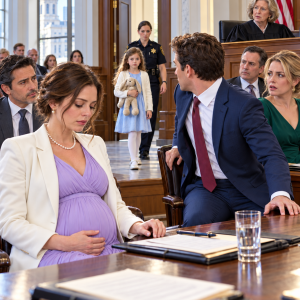
After the government presented its initial evidence, Pierce rose and argued that the company’s true owner, retired Air Force General Wallace Harwood, could no longer authorize access to internal records.
Wallace was Julian’s grandfather and the founder of the business. He had built the company after serving as a transport pilot, then stepped away from daily operations when his health weakened. Margaret had told everyone that his memory was fading and that she now held complete authority over his affairs.
Pierce lifted the signed medical statement. “This evaluation confirms that General Harwood cannot reliably review corporate information or provide informed testimony. Any material allegedly obtained with his approval must therefore be treated as unauthorized.”
Margaret turned toward us with the faintest smile. I understood their plan. If Wallace could be declared incapable, they could challenge Rebecca’s access to the original ledgers and maintain that Margaret alone had the right to speak for the company.
The rear doors opened before the judge could respond.
Wallace Harwood entered with a cane, wearing a charcoal suit and the silver wings he had earned decades earlier. An independent physician walked beside him, followed by two military attorneys. His steps were slow, but his gaze was clear.
Margaret rose abruptly. “Wallace, you shouldn’t be here. Let me take you home.”
He passed her without answering and stopped near Rebecca.
“Your Honor, I owe this young woman an apology,” he said. “She warned me months ago that something was wrong inside my company, and I asked her to wait while I verified it. I believed discretion would protect the family and our employees. Instead, my delay left her alone with people willing to silence her.”
Pierce tried to interrupt, but Wallace raised one hand.
“I completed an independent neurological examination this week,” he continued. “I am fully able to understand my business and my legal decisions. The statement submitted today was prepared by a physician I have not consulted in more than a year, and I did not authorize it.”
The judge studied the document, then directed the clerk to preserve it for further review. Margaret’s smile vanished.
Wallace reached into his pocket and removed a small silver locket. I recognized it immediately. I had bought it for Rebecca at a county fair when she was ten, and although the Harwoods considered it too plain for their formal events, she wore it whenever she needed to remember who she had been before their wealth began telling her who she ought to become.
Wallace placed the locket on the evidence table and opened its hidden compartment. Inside was a tiny storage device.
“Rebecca brought this to me six months ago,” he said. “It contains copies of the original ledgers, vendor agreements, and account authorizations. My private auditors compared them with company records and confirmed that the files are genuine.”
Julian leaned toward his attorney, whispering urgently, while Preston stared at the table. Margaret gripped the edge of her chair.
Wallace then produced a notarized amendment to the Harwood Family Trust.
“After verifying the first transfers, I added a misconduct provision,” he explained. “If a company officer was formally investigated for misusing federal funds, that officer’s voting authority would be suspended. Temporary control would pass to the person who disclosed the misconduct and preserved the evidence.”
The judge read the amendment in silence.
Margaret finally found her voice. “You would hand the company to an outsider?”
Wallace looked at Rebecca with regret and respect. “She stopped being an outsider the day she chose to protect the people this company was created to serve. Effective immediately, Rebecca holds the controlling vote while the investigation proceeds.”
The court maintained the freeze on the disputed accounts, referred the questionable medical statement for review, and ordered the Harwoods to have no contact with Rebecca outside their attorneys. As officers escorted the family from the room, Margaret turned back.
“You have taken everything from us,” she said.
Rebecca stood, still pale, still unsteady, but no longer lowered her eyes.
“No, Margaret,” she replied. “I only told the truth about what you chose to do.”
What Rose in the Garden
Eight months later, the garden cottage was gone. Rebecca had asked that it be removed, not because she wanted to erase the past, but because she refused to let the worst place in her life remain the final shape of the land.
In its place stood the Sunrise Advocacy Center, a light-filled building offering temporary housing, counseling, financial guidance, and legal support to military families facing coercion at home. Rebecca used the company’s restored charitable funds to establish it, while Wallace—still mentally sharp though physically frail—gave the project the first private donation.
The investigation continued, and Rebecca never pretended a court order had healed everything. Recovery arrived quietly, through ordinary choices: answering a friend’s call, opening her own mail, and learning that peace did not need anyone’s permission.
On the center’s opening day, I stood beside her in uniform while veterans, nurses, attorneys, and neighbors gathered beneath the Colorado sun. Wallace sat near the front, holding the ceremonial scissors with both hands. Above the entrance, a bronze plaque carried a sentence Rebecca had chosen:
NO NAME IS POWERFUL ENOUGH TO OUTRANK THE TRUTH.
After the guests moved into the courtyard, Rebecca touched the small locket at her throat.
“I used to think calling you meant I had failed,” she said. “I kept telling myself that strong women solve their own problems.”
I took her hand. “Strong people know when a burden should not be carried alone.”
She looked toward the new building, where a young mother was speaking with an attorney while her children drew pictures at a sunlit table.
“I wish I had called sooner.”
“So do I,” I admitted. “But you called when you could, and then you told the truth when it mattered.”
Rebecca leaned her head briefly against my shoulder, reminding me that independence and love had never been opposites, and that accepting help could be an act of judgment rather than surrender.
What the Harwoods tried to conceal became the foundation for something useful. Their locked cottage was replaced by open doors, their managed story by Rebecca’s clear voice, and their faith in influence by a principle sturdier than money: character is revealed by what a person does when telling the truth carries a cost.
My daughter had not emerged unchanged, yet fear was no longer directing her life. With patience and courage, she had turned the place where her voice was nearly taken from her into a place where other voices would finally be heard.