PART 1: THE SEAT BESIDE MY MOTHER’S NAME
The woman carrying my husband’s supposed child placed one manicured hand on the back of my chair and asked me to move as though I were an inconvenient guest at an event paid for by my own family foundation.
My name is Caroline Whitaker Mercer, and the moment happened beneath crystal chandeliers at the annual donor dinner for St. Catherine Medical Center in Boston, where two hundred donors, hospital executives, trustees, journalists, and civic leaders had gathered to dedicate a maternal recovery wing promised by my late mother.
The plaque waiting beneath a midnight-blue cloth carried Eleanor Whitaker’s name.
My mother had spent the final years of her life designing and funding a program for women recovering after traumatic childbirth, emergency hysterectomies, stillbirths, pregnancy loss, and other experiences that hospitals too often treated as administrative complications rather than human catastrophes.
She understood that pain personally because she had sat beside me through two miscarriages.
After the second, I had apologized while staring at a hospital ceiling because grief had convinced me that my body had failed everyone.
My mother held my face between both hands.
“You did not fail, Caroline, and you are never going to let anybody measure your value by what your body could not produce.”
My husband, Harrison Mercer, had been in the room that day.
He cried beside me.
He promised our marriage was larger than children.
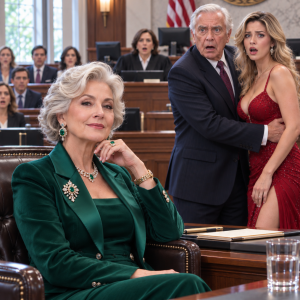
Eleven years later, he stood beside his visibly pregnant mistress at my mother’s memorial dinner with one hand resting possessively against the small of her back.
Her name was Celeste Vaughn.
She wore a pale champagne maternity dress selected with the kind of intelligence that knew exactly how photographs worked. The dress was elegant without looking bridal, soft without looking theatrical, and fitted closely enough that nobody could possibly miss her six-month pregnancy.
“Harrison thought it would look better if I sat here,” she said.
I looked at the place card.
CAROLINE WHITAKER MERCER.
My aunt Margaret’s name appeared to my right, while the chair on my left was reserved for Allison Grant, the fifty-two-year-old director overseeing the hospital foundation campaign.
“Better for whom?” I asked.
Celeste smiled.
“For the future.”
Harrison exhaled impatiently.
“It is one chair, Caroline. Do not turn this into something ugly tonight.”
Ugly.
Not humiliating.
Not cruel.
Not adulterous.
Ugly, apparently, was my reaction.
Celeste touched her belly.
“Children are the future. Wives eventually become part of the past.”
A fork stopped against porcelain somewhere behind us.
Harrison did not correct her.
Instead, his hand tightened reassuringly against her waist.
I looked toward the black leather portfolio resting in front of my place setting.
Inside was the donor agreement Harrison had signed the previous month without reading carefully enough.
Inside my evening bag was my wedding ring, which I had removed twenty-six days earlier.
Underneath my plate was a sealed envelope containing a prenatal paternity report Harrison would have paid almost anything to keep hidden.
I touched none of those things yet.
My mother used to say dignity was mostly a matter of timing.
People often misunderstood that to mean silence.
Sometimes silence simply gave another person enough room to finish destroying himself.
So I smiled.
“Perhaps the future should wait until the paternity results are discussed.”
Celeste’s face changed.
Only for a second, but I saw the color disappear beneath her makeup.
Harrison saw it too.
“Caroline.”
His warning carried the familiar tone of a man accustomed to treating his wife’s dignity like furniture that could be rearranged when guests arrived.
Celeste recovered first.
“I did not come here to cause trouble.”
“No,” I replied. “You came here to take my chair.”
Harrison leaned close enough for me to smell the cologne I had once bought him in Paris.
“You are finished after tonight.”
I looked directly at him.
“I was finished twenty-six days ago.”
Fear appeared in his eyes.
That was the first genuine emotion he showed me all evening.
PART 2: WHAT HARRISON BELIEVED HE OWNED
To understand why Harrison became frightened, you must understand what he had always believed about me.
My mother died fourteen months before the dinner.
Her illness gave us eight months of warning and somehow no time at all.
When she died, I inherited her voting position within the Whitaker Family Foundation, not the foundation itself. Nobody personally owned it. It had an independent board, donor agreements, governance requirements, and restrictions my grandfather had deliberately created because he believed family money became dangerous when blood was confused with authority.
Harrison hated those rules.
He called them outdated, overly formal, and unnecessary.
He had married into the Whitaker family and gradually begun behaving as though proximity granted him ownership.
My mother noticed long before I did.
Years earlier, after Harrison left our apartment following an argument, she quietly said:
“He loves you, Caroline, but I am not certain he understands the difference between loving something and believing it belongs to him.”
I became angry with her.
Harrison had supported me through fertility treatment, pregnancy loss, my mother’s cancer, and years of foundation obligations. I mistook acts of care for proof that entitlement could not exist beside love.
I was wrong.
Twenty-six days before the donor dinner, Harrison came home late while I worked in my mother’s library.
He poured himself whiskey and stood near the window until I finally asked the question neither of us wanted.
“Are you planning to leave me?”
He turned.
“Would that make things easier?”
“For whom?”
He rubbed one hand across his mouth.
“There is someone else.”
Eleven years of marriage collapsed into four words.
The affair had lasted eight months.
The woman was Celeste, somebody who had worked with Harrison on several philanthropic campaigns.
I knew her.
She had attended my mother’s funeral, held my hand, and told me Harrison was lucky to have me.
Then Harrison told me she was twenty-four weeks pregnant.
“I love her,” he added.
I laughed once, although nothing was funny.
“Of course you do.”
His face hardened.
“Do not make this dirty.”
That sentence ended whatever love remained inside me.
Not the pregnancy.
Not even the affair.
The moment he demanded that I preserve dignity around his betrayal, I understood that he expected me to carry the discomfort so he could keep the story clean.
He wanted us to delay announcing our separation until after the hospital dinner.
Then he began requesting other things.
Celeste should attend for transparency.
I should publicly acknowledge the child for compassion.
Hospital materials should mention “the next generation of Mercer-Whitaker philanthropy” for continuity.
Celeste should appear near the central donor table for stability.
Every demand came wrapped inside a reasonable word.
Every reasonable word meant the same thing.
Move aside.
Then Allison Grant called me one week before the dinner.
“Caroline, has Harrison discussed alternative naming language with you?”
My hand tightened around the phone.
“What alternative naming language?”
There was a pause.
“Mercer Future Maternal Recovery Center.”
I closed my eyes.
“He asked you to remove my mother’s name?”
“He presented it as a combined legacy proposal. I did not approve anything.”
My aunt Margaret arrived that afternoon carrying the amended donor agreement.
She had been my mother’s younger sister and possessed none of Eleanor’s patience.
“Your husband has been calling trustees and describing Celeste’s unborn child as the next Mercer heir connected to the Whitaker legacy.”
I stared at her.
“He has no authority to make that representation.”
“Correct, which is why your mother wrote Clause Fourteen.”
The clause allowed the foundation to revoke the representative status of any affiliated person who publicly misrepresented donor authority, naming rights, governance control, or inheritance claims.
Then Margaret showed me Clause Seventeen.
Any child represented in official foundation communications as an heir for governance or inheritance purposes required legally verified family status.
“Why is this so specific?”
Margaret almost smiled.
“Because your mother had already watched another relative attempt something similarly foolish years ago.”
Harrison had signed the amended agreement one month earlier in his honorary campaign role.
He had not read it.
That fact would become expensive.
PART 3: THE REPORT BEHIND CLAUSE SEVENTEEN

Three nights before the dinner, I searched the library for the final donor file.
Harrison had been working there earlier before leaving to meet Celeste.
His papers remained on my mother’s desk.
A revised seating chart.
Communications notes.
A draft speech.
A proposed sign reading MERCER FUTURE MATERNAL RECOVERY CENTER.
He had already designed his name over my mother’s legacy before receiving a single authorization.
Then I found the laboratory report folded behind Clause Seventeen.
PRENATAL PATERNITY ANALYSIS.
Celeste Vaughn.