I’d lost my father.
I’d lost my marriage.
And I’d lost the belief that the man who’d slept beside me for three years respected my independence.
But I’d protected the property Dad had spent forty years developing.
More importantly, I’d stopped allowing people to decide what I owed them simply because we were related.
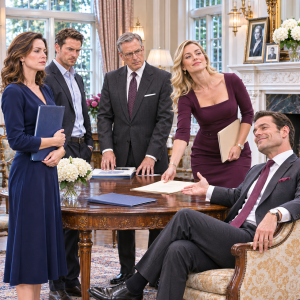
One morning, Susan handed me the final documents confirming my authority over the remaining estate assets.
She looked at me kindly.
“Your father took extraordinary care to preserve these records, Olivia. But you’re the person who chose to act when the evidence revealed what was happening.”
I studied Dad’s signature.
For the first time since the funeral, I could imagine my future without Derek standing beside me demanding a share of it.
PART 7 — THE AUTOMOTIVE TRAINING CENTER THAT HONORED MY FATHER

Eventually, Hillcrest approached me about negotiating directly for the property.
Its representatives remained interested in the location.
But I had no intention of selling everything Dad had spent his life building.
After consulting an architect, local business owners, and my accountant, I decided to sell only a narrow strip of land facing the road.
The proceeds helped finance improvements to the repair facilities while preserving the main acreage.
Working alongside our longtime neighbor Patricia Owens, who owned an auto-parts store across the road, I developed a plan to construct six independent repair bays.
We also established a practical automotive training center for young people interested in becoming skilled mechanics.
Obtaining environmental permits, improving ventilation, and securing construction approvals took months.
The opening day was far from perfect.
An aging air compressor broke down just as the first students arrived.
The instructors had to borrow equipment from another workshop.
Then a nineteen-year-old girl named Grace entered wearing a faded denim jacket.
She looked around uncertainly.
“Do you accept women in the training program? Someone told me you teach people who haven’t had an opportunity to learn professionally.”
I smiled.
“We accept anyone willing to work hard and learn, Grace. Engines don’t care whether the person repairing them is a man or a woman.”
Within a week, Grace identified an electrical fault that had frustrated several older students.
Watching her confidence grow reminded me of something Dad had always believed.
Practical knowledge was a form of independence nobody could steal.
Our workshop began providing affordable space to local mechanics.
The training center created opportunities for people seeking stable employment.
I placed Dad’s old red toolbox on the instructor’s table.
Inside its lid, he’d scratched a sentence decades earlier.
What you learn to build with your mind and hands can never truly be taken away.
I traced the uneven letters.
Dad had left me valuable property.
But he’d also given me something worth far more.
The confidence to decide what that property should become.
PART 8 — THE INHERITANCE MY FATHER ACTUALLY WANTED ME TO HAVE
On the afternoon we installed the dedication plaque for the Harold Bennett Automotive Training Center, I stood outside the workshop watching students move between the newly equipped repair bays.
The sounds of tools, engines, and conversation filled the building.
For a moment, I imagined Dad walking around the corner with his chipped coffee mug, checking whether everyone had organized their equipment properly.
I still missed him every morning.
Sometimes I also missed the husband I’d believed Derek was.
But I’d learned that missing someone didn’t mean wanting that person back.
Derek eventually sent a handwritten apology through our attorneys.
I chose not to open it.
I understood that financial desperation could make people frightened.
But it didn’t justify stealing someone’s identity, forging documents, or attempting to take an inheritance.
Some acquaintances suggested I’d been unnecessarily harsh.
They believed I should’ve settled everything privately to spare Derek’s family public embarrassment.
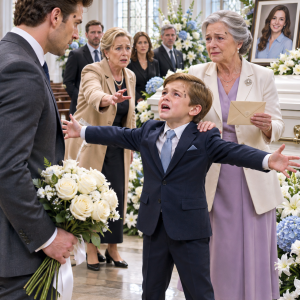
Whenever their comments unsettled me, I remembered his fingers tightening around my wrist beside Dad’s coffin.
I remembered the forged signature.
And the recording in which Derek confidently predicted that I’d sign anything he placed before me.
Most of all, I remembered Dad’s warning.
He hadn’t wanted me to seek revenge.
He’d wanted me to know the truth before deciding my future.
For years, I’d helped him manage Bennett Auto and Diesel Repair.
I’d reviewed invoices, balanced accounts, tracked expenses, and watched him negotiate with customers who couldn’t always afford the repairs their vehicles needed.
He’d taught me that running a business meant more than calculating profits.
It meant recognizing how many people depended on the decisions made inside that office.
Derek and his family saw Dad’s five acres as an opportunity to eliminate their debts and purchase a more luxurious lifestyle.
Dad saw the property differently.
It represented forty years of work.
It provided livelihoods for skilled mechanics.
And it held possibilities that extended far beyond its market value.
I could have sold the entire property to Hillcrest.
The offer was substantial.
After everything I’d endured, taking the money and beginning somewhere else might have been the easiest decision.
But I wanted to preserve what Dad had built while giving it a future that reflected his values.
Selling only the narrow strip of road-facing land allowed me to fund improvements without sacrificing the repair shop and its surrounding acreage.
The new repair bays gave independent mechanics affordable places to work.
The training center created opportunities for young people who needed practical skills and a path toward reliable employment.
That mattered to me more than an expensive house in Alamo Heights ever could.
I thought about Grace.
She’d entered the workshop wondering whether a young woman would be welcome in a profession she’d always wanted to pursue.
Within days, she’d demonstrated remarkable technical ability.
Her confidence grew because somebody had given her an opportunity to learn.
That was the kind of legacy I wanted Dad’s business to leave.
Not merely land passed from one generation to another.
But knowledge, opportunity, and independence shared with people who might otherwise be overlooked.
That afternoon, Grace approached carrying an application from another young woman interested in joining the next training group.
I accepted it.
She smiled, and together we walked back into the workshop.
My inheritance hadn’t purchased Barbara’s mansion.
It hadn’t rescued Trevor’s failing restaurant.
And it hadn’t allowed Derek to turn my father’s property into collateral for financial obligations I’d never agreed to accept.
Instead, it was supporting local businesses, teaching young people valuable skills, and preserving the work Dad had loved.
I looked toward the dedication plaque bearing his name.
For the first time since his funeral, the memories no longer felt overwhelmed by betrayal.
I could remember him standing in the repair shop with grease on his hands, explaining patiently how an engine worked.
I could remember his pride whenever a young apprentice mastered something difficult.
And I could remember the warnings he’d left because he understood that trust shouldn’t require surrendering control.
He’d protected me as much as he could while he was alive.
After his death, I finally learned how to protect myself.
My husband believed my father’s death would make his family wealthy, but the evidence Dad left behind protected everything he’d spent his life building.
In the end, the greatest inheritance wasn’t land worth millions of dollars. It was the freedom to decide that nobody would ever again use my trust as permission to control my life.
I stepped back into the workshop, where another group of students was preparing to begin their lessons.
And for the first time in a long while, the future felt entirely my own.
THE END