The Things My Daughter Left Behind

A Promise Beside the Grave
My son-in-law waited until the minister had finished the final prayer before announcing that he no longer wanted his children.
Nearly two hundred people were still gathered beneath the old oak trees of a quiet cemetery outside Charlottesville, Virginia. A light spring rain had passed through earlier, leaving the grass wet and the air scented with earth and white roses. My daughter Julia’s coffin had just been lowered, and her three girls stood beside me in matching navy coats, each of them trying in her own way to understand why their mother would never walk through the front door again.
Twelve-year-old Avery held Julia’s photograph against her chest. Nine-year-old Beth stared at the flowers without blinking, while six-year-old June pressed herself against my side and clung to my hand.
Their father, Bradley Keene, stood several feet away in a perfectly tailored charcoal suit. His shoes were polished, his silver watch gleamed beneath his cuff, and his expression carried none of the tenderness I would have expected from a husband saying farewell to his wife of fourteen years.
His phone vibrated. He glanced at the screen, and for the briefest moment, a smile appeared at the corner of his mouth.
Then he looked toward the girls and spoke loudly enough for everyone nearby to hear.
“If no one in this family wants to take responsibility for them, I’ll contact social services on Monday. Paige and I are starting a new life, and she didn’t agree to raise three children who aren’t hers.”
At first, I thought grief had caused me to misunderstand him.
“What did you say?” I asked.

Bradley exhaled impatiently, as though I had interrupted an important business meeting.
“Martin, please don’t make this harder than it needs to be. Julia is gone. I’m still young, and I have the right to move forward.”
“Those are your daughters.”
He gave them a passing glance.
“They’ve never liked Paige, and Paige doesn’t want them living with us. You’re their grandfather. If you care so much, you can take them.”
A silence spread through the mourners. Julia’s aunt covered her mouth. One of Bradley’s cousins lowered his head, embarrassed to be standing near him. Even the minister seemed unable to find words.
For one heated second, I imagined grabbing Bradley by the collar, but then June tightened her fingers around mine, and every ounce of anger in me turned into a promise.
I looked down at my granddaughters. Avery wasn’t in tears. Her face was pale, but her expression was strangely controlled. She looked at Beth, Beth looked at June, and something passed silently among the three sisters—an understanding that felt too serious for children their age.
They already knew something.
I knelt in front of them.
“You’re coming home with me,” I said. “All three of you.”
Bradley gave a small laugh.
“Good. Then that’s settled.”
He did not embrace them. He did not ask whether they had packed clothes or whether June still needed her evening medicine. He simply turned and walked toward a black SUV waiting near the cemetery entrance.
A blonde woman in oversized sunglasses sat in the passenger seat. The moment Bradley opened the door, she leaned toward him with a pleased smile.
The vehicle pulled away without either of them looking back.
The Purple Bag

My house had not held children for many years, and that first evening every room seemed to remind me how unprepared I was. I found extra blankets, cleared space in the closets, and made soup that none of us could finish. Beth asked to wear one of Julia’s old college shirts, which I had kept in a cedar chest. June refused to sleep unless I sat beside her, so I remained there until her breathing became slow and even.
Avery stayed near the living-room window, watching the dark yard.
Shortly after three in the morning, I found her standing in the kitchen doorway. She was holding a small purple cloth bag against her chest.
“Grandpa, can I tell you something?”
I pulled out the chair beside me.
“You can tell me anything.”
She sat down but kept both hands wrapped around the bag.
“Mom didn’t leave us only because she was sick.”
My hand stopped around my coffee cup.
“What does that mean?”
Avery loosened the drawstring and placed three objects on the table: an older cellphone, a worn green notebook, and a small USB drive.
“Mom gave this to me last winter,” she explained. “She made me promise not to tell Dad. She said that if she couldn’t protect us herself, I had to give it to someone who still loved her.”
I opened the notebook carefully. Julia’s handwriting covered every page. Some entries recorded dates and medication changes. Others described financial papers Bradley had pressured her to sign when she was weak or confused. She had written down conversations, appointment times, account numbers, and the names of people who might be able to confirm what had happened.
The phone contained recordings.
In one, Julia’s voice sounded exhausted.
“This new prescription makes everything feel blurred. I told the doctor, but he says he never approved the change.”
Bradley answered in the soothing voice he often used when he wanted others to believe he was being reasonable.
“You’re confused again. Sign the trust amendment, take what I gave you, and get some rest.”
Another recording captured an argument about Julia’s company. She had inherited a controlling interest in a regional medical-equipment firm from her mother and had intended for her daughters to receive her shares through a protected family trust.
Bradley wanted control of those assets.

The USB drive contained copied emails, pharmacy records, corporate transfers, and security logs suggesting he had used another employee’s credentials to request changes that Julia’s physician had never authorized.
When I finally looked up, Avery was watching me.
She appeared brave, but she was still a twelve-year-old girl sitting in her grandfather’s kitchen before sunrise, carrying a burden that should never have been placed upon her.
“Did your sisters know about this?”
“Beth knew about the notebook. June only knew we had to keep the purple bag hidden.”
“Where did you keep it?”
“Inside the lining of Mom’s old sewing basket. Dad searched her office, but he never looked there.”
I reached across the table and covered her hand with mine.
“You did exactly what your mother asked. From now on, this is an adult problem. Your job is to be a child again.”
Her composure finally gave way, and she leaned into me.
“Can we really stay here?”
“For as long as you want. No one is sending you anywhere.”
The Quiet Work

The next morning, I contacted Rebecca Lawson, an attorney I had known for almost twenty years. She specialized in family trusts and financial misconduct, and after reviewing copies of Julia’s notebook and recordings, she asked me not to confront Bradley.
“If he realizes what you have, records may disappear,” she warned. “Let him believe you’re overwhelmed. Let him believe he has won.”
So for the next two months, I played the role Bradley expected: an aging grandfather struggling to manage three grieving children.
In reality, Rebecca assembled a team that included a forensic accountant, a family-law specialist, and a former pharmacy compliance investigator. They verified Julia’s files one item at a time. The altered prescription requests matched the dates in her notebook. Corporate transfers led to accounts Bradley controlled. Several signatures appeared to have been obtained when Julia was too unwell to understand the documents properly.
Meanwhile, I petitioned for full custody.
Bradley did not object. He arrived at the attorney’s office wearing a navy designer suit and spent most of the meeting checking his watch. Paige was waiting for him at a resort in the Blue Ridge Mountains, where they were planning a lavish wedding.
“Let’s finish this,” he said, flipping impatiently through the papers. “I have somewhere to be.”
Rebecca pointed to the section explaining that he would surrender not only day-to-day parental authority but also any right to manage assets held for the girls.
“You should read this carefully,” she told him.
Bradley smiled at me as if I were too foolish to understand my own legal documents.
“I know what it says. Martin gets the responsibility, and I get my freedom.”
He signed every page.
What Bradley failed to understand was that Julia’s trust contained a safeguard created years earlier by her mother. Any parent who voluntarily gave up guardianship of Julia’s children also gave up the right to serve as trustee or direct their inheritance. The moment Bradley signed, control of the girls’ accounts moved to an independent fiduciary.
The two-million-dollar distribution he expected after his wedding was also placed on hold while investigators examined the disputed transfers.
Bradley walked out of the office smiling.
I went home to help Beth with a science project, read June a bedtime story, and tell Avery that her mother’s plan was beginning to work.
The Wedding That Never Began

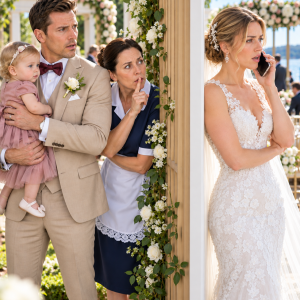
Bradley and Paige chose the most expensive ballroom at a luxury mountain resort near Roanoke. White orchids covered the altar, silk ribbons hung from the balconies, and enormous screens displayed photographs of the couple beside carefully chosen messages about second chances.
The irony would have amused me under different circumstances.
When the ballroom doors opened that Saturday afternoon, Bradley was standing near the altar in an ivory dinner jacket, laughing with a group of investors. Paige waited in a private room upstairs, wearing a gown that reportedly cost more than many families earned in a year.
I entered wearing the same dark suit I had worn at Julia’s funeral.
Rebecca walked beside me. Two state investigators and a federal financial agent followed us. Behind them came Avery, Beth, and June, all dressed in simple pale-blue dresses Julia had purchased the previous Christmas.
The music stopped unevenly. Conversations faded as the guests turned toward us.
Bradley set down his champagne glass and hurried into the aisle.
“What are you doing here?” he demanded. “You weren’t invited. Neither were the girls.”
“We didn’t come as guests,” I replied. “We came to carry out Julia’s final instructions.”
His face tightened.
“Security!”
One of the state investigators stepped forward and showed his badge.
“Security has been informed, Mr. Keene. We have a warrant concerning financial fraud, unlawful access to protected pharmacy systems, and the deliberate interference with a dependent person’s medical care.”
Bradley took a step backward.
“That’s ridiculous. Julia had a long-term condition. Her records are private.”
Avery moved beside me, holding her mother’s green notebook in both hands.
“They aren’t hidden anymore,” she said. “Mom kept copies of everything.”
Rebecca connected the recovered phone to the ballroom’s presentation system. The romantic slideshow disappeared, replaced by a dated audio file and a page from Julia’s notebook.
Julia’s voice filled the room.
“Bradley, my doctor says he never changed my prescription. Why are the labels different?”
His recorded answer followed.
“You’re not remembering correctly. Sign the company papers, and I’ll sort it out tomorrow.”
Another recording played.
“I don’t want you controlling the girls’ trust.”
“Then Paige and I will make sure you regret making this difficult.”
Several guests rose from their seats. One of Bradley’s business partners quietly walked out. Another moved away from the altar as if physical distance might separate him from the scandal.
Bradley turned toward his attorney.
“Tell them these recordings can’t be used.”
The attorney studied the investigators, then looked down at the floor.
“Bradley, I advised you weeks ago to disclose any disputed transactions. You told me there were none.”
“Fix it!”
“I can’t fix facts you concealed from me.”
Paige appeared at the side entrance, still wearing her veil. She looked from Bradley to the investigators and then to the frozen bank-account notice Rebecca had placed on a nearby table.
“What happened to the settlement?” she asked.
Bradley did not answer.
I did.
“It was never his to claim. The money belongs to Julia’s daughters, and he signed away his ability to control it.”
Paige stared at him.
“You told me the money had already cleared.”
“It will,” he insisted. “This is temporary.”
The federal agent shook his head.
“The accounts have been secured pending the investigation.”
Paige removed her engagement ring and placed it beside Bradley’s untouched champagne glass.
“Then there won’t be a wedding.”
She walked back through the side door, followed moments later by her parents.
Bradley stood alone beneath the orchids, surrounded by flowers purchased to celebrate the future he believed he had stolen. The investigators approached and informed him that he was being taken into custody. He did not resist.
As he was escorted down the aisle, he looked at his daughters for the first time that day.
Beth turned toward me. June hid behind my coat. Avery remained still, not triumphant and not cruel, but certain that she no longer needed to fear him.
What We Carried Home

When the ballroom doors closed, the room remained silent. I did not care what Bradley’s guests thought, nor did I feel satisfaction in watching his carefully constructed life collapse. I wished only that Julia had been there to take her daughters home herself.
June tugged gently at my sleeve.
“Is it finished, Grandpa?”
I knelt and gathered all three girls into my arms.
“The hardest part is finished,” I told her. “You’re safe, your mother’s wishes will be honored, and we’re going home.”
The legal process continued for many months. Bradley eventually faced charges related to financial misconduct, unauthorized record access, and interference with Julia’s care. The company recovered much of what he had diverted, and every protected asset was returned to the trust Julia had created for her daughters.
But healing did not arrive through court documents.
It came quietly.
It came when Beth began laughing at the dinner table again, when June stopped asking whether someone might take her away, and when Avery finally left the purple bag in my desk instead of keeping it beneath her pillow.
On the first anniversary of Julia’s passing, we planted a white dogwood tree in the backyard. Each girl placed something beneath its roots: Beth added a handwritten letter, June left a blue ribbon, and Avery placed a copy of the final page from her mother’s notebook.
Julia had written only one sentence there:
“Whatever happens to me, let my girls know that they were the bravest and most beautiful part of my life.”
That evening, the four of us sat beneath the young tree as sunlight filtered through its leaves. We still missed her. We always would. Yet the sorrow no longer felt like an empty room. It had become something we carried together, softened by memory, strengthened by truth, and held in place by the family Julia had fought so carefully to protect.
Bradley had believed that abandoning his daughters would give him a fresh beginning.
Instead, the new beginning belonged to them.