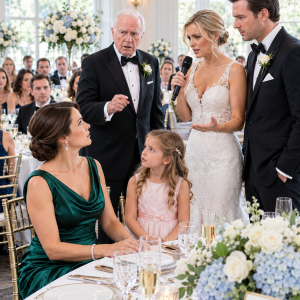
Years earlier, he had worked at one of the clinics Graham and Laurel visited.
The doctor looked deeply uncomfortable.
“Mr. Ashford, I believe you deserve an explanation.”
Laurel came into the hallway.
“About what?”
Dr. Rusk opened the case.
Inside were copies of old records.
“Years ago, certain information connected to your case was removed before you personally reviewed it.”
Graham looked at Sloane.
Her face had changed.
“What information?”
The doctor pulled out a report.
“A later test established that there was no evidence supporting the assumption that Laurel was unable to become a mother.”
Laurel covered her mouth.
Graham felt sick.
Dr. Rusk continued.
“And after the twins were born, another private test was requested.”
He placed the document in Graham’s hands.
Graham looked at the names.
Then the conclusion.
He did not need the doctor to explain it.
Everett and June were his children.
“Who requested this?”
Dr. Rusk hesitated.
Graham looked directly at Sloane.
“Who?”
Sloane finally spoke.
“Your mother wanted certainty.”
Patricia shook her head.
“Don’t put this entirely on me.”
Graham looked between them.
There it was.
Not one dramatic conspiracy created in a single afternoon.
Something worse.
Years of small decisions.
Letters.
Silence.
Assumptions.
Information withheld because two people believed they had the right to decide what Graham should know.
What Money Could Never Buy Back
Graham returned to Room 412.
Everett was drawing on a notepad.
June sat beside her grandfather.
Seven years.
That number suddenly felt enormous.
Seven birthdays he had never attended.
Seven Christmas mornings.
First words.
First steps.
First days of school.
Loose teeth.
Nightmares.
Favorite books.
Inside jokes.
All the ordinary moments that turn strangers into family.
Graham had spent his career believing money could repair almost anything.
Buildings could be rebuilt.
Companies could recover.
Contracts could be renegotiated.
Mistakes could sometimes be settled with enough resources and enough determination.
But there was no account large enough to purchase Everett’s first six birthdays.
There was no check that could return the nights Laurel had raised two babies alone.
There was no lawyer capable of negotiating seven missing years back into existence.
Everett looked up.
“Are you leaving?”
Graham crouched several feet away from him.
“Not unless your mom wants me to.”
The boy considered that.
“Are you going to come back tomorrow?”
Graham looked toward Laurel.
She did not answer for him.
That mattered.
He turned back to his son.
“If your mother says it’s okay, I would like to.”
June climbed down from her chair.
“Do you have kids at your house?”
The question nearly broke him.
“No.”
“So we’re your only kids?”
Graham nodded.
“Yes.”
June thought for a moment.
Then she said,
“That’s weird.”
Dennis laughed softly from the bed.
For the first time that night, Graham smiled.
“It definitely is.”
No More Promises
Later, Laurel walked Graham toward the elevators.
He wanted to apologize again.
He wanted to explain everything.
Instead, he realized that explanations were becoming another way of asking Laurel to carry his emotions.
So he kept it simple.
“I was wrong to leave you the way I did.”
Laurel looked ahead.
“Yes.”
“And even without what my mother did, I still have to take responsibility for believing what was convenient instead of asking harder questions.”
She finally looked at him.
“Yes.”
“I can’t give those years back to you.”
“No.”
Graham swallowed.
“But if you’ll allow it, I want to know Everett and June. Slowly. On your terms. I won’t arrive with expensive gifts and pretend that makes me their father. I won’t force them to call me anything. I won’t make promises I haven’t earned the right to make.”
Laurel studied him for a long time.
“They don’t need your money.”
“I know.”
“They need consistency.”
“Then that’s what I’ll give them.”
Laurel shook her head slightly.
“You can’t give consistency in one conversation.”
Graham nodded.
“Then I’ll start tomorrow.”
The elevator doors opened.
Before he stepped inside, Laurel spoke again.
“Graham.”
He turned.
For the first time since he had arrived, the anger in her expression softened slightly.
“Tomorrow at ten. Don’t be late.”
The doors closed before he could answer.
But for once, Graham understood that he did not need another speech.
He simply needed to be there.
Sometimes the most painful losses do not happen because love disappears; they happen because pride, fear, and assumptions become louder than the honest conversations that might have saved what mattered most.
A relationship can survive difficult news more easily than it can survive two people quietly withdrawing from each other while pretending that silence is protecting them from pain.
Never allow another person’s certainty to replace the questions you have a responsibility to ask for yourself, especially when the answer could change the direction of someone’s entire life.
Parents may want to protect their adult children, but protection becomes control the moment they begin hiding truths, making decisions, or closing doors that were never theirs to close.
Money can provide comfort, security, opportunity, and second chances in many areas of life, but it can never purchase the ordinary days we failed to spend beside the people who needed us.
Children should never carry shame for choices made before they were old enough to understand them, because they are not responsible for the fears, mistakes, resentments, or unfinished conflicts of adults.
An apology has meaning only when the person giving it accepts that forgiveness may take time and understands that changed behavior must continue long after the emotional conversation has ended.
The truth can be painful when it arrives late, yet even a difficult truth gives people the opportunity to make real choices, while a carefully maintained lie quietly takes those choices away.
Trust is rarely rebuilt through one grand gesture; it returns through ordinary acts repeated consistently—showing up when promised, listening without defending yourself, respecting boundaries, and staying when leaving would be easier.
And sometimes the strongest way to repair what has been damaged is not to demand another chance, but to become the kind of person who can patiently earn one, day after day, without assuming that love automatically erases the past.