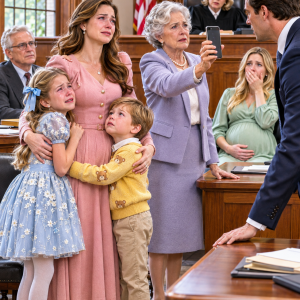
After the hearing, I found Margaret sitting alone near a courthouse window.
For a moment, I remembered the woman who had taught me how to ride a bicycle, baked apple pies on Thanksgiving, and waited beside the front door whenever I came home late as a teenager.
Those memories were real, but so was everything Oliver had endured.
“I hope you’re pleased with yourself,” she said when she noticed me approaching. “You’ve taken my grandson away from me.”
I sat down a few feet away.
“Mom, Oliver went through another operation because of what happened in that hospital room.”
“I was trying to prepare him for the real world. He’s far too sensitive.”
“He’s a thoughtful, compassionate boy who spent years making you birthday cards even when he was frightened of being alone with you. I think that takes more strength than you realize.”
She looked away.
I asked whether she could acknowledge that she had hurt him without explaining why he supposedly deserved her treatment.
For several moments, she said nothing.
Then she shook her head.
“One day, when he has children of his own, he’ll understand.”
I knew then that there was nothing more I could accomplish through that conversation.
“If Oliver ever wants to reconsider having a relationship with you, we’ll handle that carefully and respect whatever legal protections are in place. But I will never pressure him to be around someone he fears simply because that person is family.”
As I walked toward the courthouse exit, I felt an unfamiliar mixture of sorrow and relief.
For the first time in my adult life, I had made a decision my mother strongly opposed without feeling obligated to seek her permission.
Learning What Safety Felt Like

Although Oliver’s physical recovery progressed steadily, the emotional consequences of his experiences remained long after he returned to school.
He startled whenever someone raised their voice, asked permission before helping himself to a glass of water, and apologized repeatedly whenever he believed he had inconvenienced me.
One evening, while helping me wash the dishes, he accidentally dropped a ceramic dinner plate onto the kitchen floor.
When I turned toward the noise, he was standing completely still, his shoulders drawn upward.
“Dad, I’m really sorry. I promise I wasn’t being careless on purpose.”
I fetched the broom and asked him to step away from the broken pieces.
“It’s only a plate, buddy. We’ll clean it up together.”
He watched me carefully.
“You’re not going to get mad?”
“There’s nothing to get mad about. Everybody drops things sometimes.”
His expression softened, and he went to retrieve the dustpan.
Later that evening, alone in my bedroom, I found myself thinking about how many ordinary childhood experiences Oliver had learned to associate with fear.
We continued attending counseling, and I began working with a therapist of my own, trying to understand why I had accepted certain behaviors from my mother that I would never have tolerated from anyone else.
Gradually, I learned that appreciating a parent’s sacrifices does not require surrendering one’s judgment, and that respecting an older family member does not mean allowing that person to disregard the dignity of a child.
One Sunday afternoon, Oliver joined me on the living room couch carrying his green sketchbook.
He opened it to a drawing of a hospital room. A small boy lay beneath a blanket, while a broad-shouldered man stood protectively near the doorway.
“That’s you, Dad.”
I smiled at the unusually large figure.
“You made me look like a professional football player.”
Oliver laughed.
“That’s how big you seemed when you came into my room that day.”
My eyes grew warm.
“I wish I’d understood what was happening a long time before that.”
He rested his head against my shoulder.
“But you came when I needed you.”
His words offered me comfort, although I knew they could not erase my earlier mistakes. Being the father he needed now meant accepting responsibility for the things I had failed to recognize before, rather than allowing his forgiveness to become another reason to avoid examining them.
A House With Its Lights On
Two years have passed since that Saturday morning, and Oliver is now fifteen, nearly as tall as I am, with an increasingly impressive collection of sketchbooks stacked beside his bedroom desk.
Last spring, he entered a regional student art competition and received first place for a painting depicting a small house surrounded by a fierce rainstorm. Warm golden light spilled from its windows, illuminating the front porch while the surrounding landscape remained dark.
When one of the judges asked what had inspired the painting, Oliver explained that he wanted to portray a place where someone could feel safe regardless of what was happening outside.
I was sitting among the other parents when his name was announced, and as he walked across the stage, he searched the audience until he found me.
He raised his certificate and smiled.
There was no uncertainty in his expression, no anxious glance toward another adult to determine whether he had behaved correctly. He was simply a fifteen-year-old boy enjoying something he had accomplished through his own imagination and hard work.
A few weeks later, we received a handwritten card from Rebecca, the nurse who had intervened that morning.
She had heard about Oliver’s achievement and wanted to congratulate him.
“Keep drawing, Oliver. The world needs people who notice beautiful things, and I hope you always remember that speaking up for yourself is a wonderful kind of courage.”
Oliver placed the card beside his award.
My mother has occasionally attempted to reach us through relatives, and several months ago, she sent me a six-page letter describing her loneliness, her declining health, and how much she missed her grandson.
I read every page, hoping to find a sincere acknowledgment of what Oliver had experienced.
There wasn’t one.
I haven’t responded, and although I sometimes miss the mother I remember from happier years, I refuse to make my son’s well-being the price of restoring that relationship.
One evening, while Oliver and I were eating dinner, he asked whether I believed his grandmother had ever loved him.
I considered my answer carefully.
“I think she probably loved you in the way she understood love. But loving someone doesn’t give us permission to treat them badly.”
He pushed a piece of potato around his plate before asking another question.
“What if I miss her sometimes?”
“Then you’re allowed to miss her. You’re allowed to remember the cinnamon rolls, the movies, and the good afternoons you spent together. You can appreciate those memories without pretending the difficult things never happened.”
He nodded and returned to his dinner.
It was an ordinary conversation at an ordinary kitchen table, yet I considered it one of the most meaningful signs of his recovery.
My son could finally express complicated feelings without worrying that his honesty might upset someone or tear his family apart.
For much of my life, I believed that maintaining family unity was among the greatest responsibilities a person could undertake. I still believe family is precious, but I have come to understand that genuine unity cannot be built by asking its most vulnerable members to quietly endure mistreatment.
Sometimes, protecting the people we love requires difficult conversations, uncomfortable boundaries, and decisions that other relatives may never understand.
I still remember the ice scattered across that hospital floor, the frightened expression on Oliver’s face, and the disbelief in my mother’s eyes when I stepped between them.
She had spent my childhood teaching me that a good son never challenged his mother, but on that Saturday morning, I finally understood that being a good father sometimes required me to stop being the obedient son she expected.
I cannot give Oliver back the years he spent worrying that his feelings might become a burden to me, but I can make certain that the years ahead are different.
And if there is one thing I hope my son carries into adulthood, it is the understanding that he will never have to make himself smaller, quieter, or less deserving of kindness simply to remain part of somebody’s family.
Because the people who truly love us should never require us to surrender our sense of safety in exchange for a place in their lives.