The Night There Was No Room for My Daughter

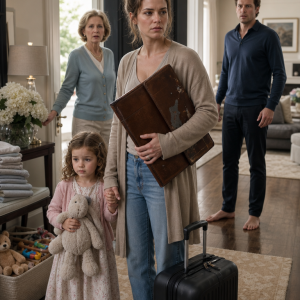
My mother said it from the doorway of the house where I had spent most of my childhood, with one hand still resting on the brass doorknob and the other holding the cardigan closed across her chest.
“You can stay for a few days, Natalie. But Maisie can’t. We simply don’t have room for her.”
For several seconds, I honestly thought I had misunderstood.
My five-year-old daughter stood beside me on the front porch, half hidden behind my coat, clutching a stuffed rabbit whose ears had become flattened from years of sleeping under her chin. We had been in the car for nearly five hours, and she still wore the leggings and sweatshirt I had thrown onto her before sunrise.
The previous night, a strong earthquake had rattled the northern California town where we lived. It had not reduced our neighborhood to ruins, but it had been strong enough to knock dishes from cabinets, split drywall above my kitchen doorway, and leave cracks along one corner of our small house. Every little sound afterward had kept me awake.
Shortly after eight the next morning, a city building inspector arrived.
He walked from room to room with a flashlight and clipboard, spent a long time studying the foundation near the back wall, then attached a notice beside my front door.
“I’m sorry,” he told me. “Until a structural engineer clears this place, you and your daughter need to stay somewhere else.”
Maisie had been standing in the driveway hugging her rabbit.
At five, she did not understand structural inspections or municipal codes. She understood only that her bedroom was suddenly off-limits, that her toys were staying behind, and that I was putting clothes into duffel bags without knowing when we would be coming home.
I called my mother immediately.
“Come here,” she said. “Of course you should come here.”
The relief I felt was so immediate that I never thought to ask whether “you” included my child.
What mother would expect her adult daughter to leave a five-year-old behind?
My parents lived outside Sacramento in the large two-story house that had belonged to my maternal grandfather. My older sister, Caroline, lived there too, along with her three children and her boyfriend, Derek.
The house was crowded, certainly, but it had four bedrooms, a den, a finished basement and a family room with a sectional sofa large enough to seat eight people.
We were not asking to move in permanently.
I thought we needed a corner for a week, perhaps two.
When Mom first opened the door, she smiled.
Then she saw Maisie.
Her expression changed so quickly that I felt my stomach tighten.
“Oh,” she said. “You brought her too?”
I gave a small laugh because I was still hoping she was joking.
“Yes, Mom. She’s five. I couldn’t exactly leave her in a house the city told us not to enter.”
My mother glanced over her shoulder.
“We thought you meant you were coming by yourself.”
Caroline appeared behind her, scrolling on her phone.
“There aren’t any extra beds, Nat.”
Maisie peered around my side.
In the tiny, careful voice she used around adults she was unsure of, she said, “Grandma, I can sleep on the couch.”
My mother sighed.
“Sweetheart, it isn’t that simple.”
Something inside me became very still.
I looked toward the staircase.
“Where are Caroline’s kids sleeping?”
Mom frowned as if the answer should have been obvious.
“They live here.”
Four words.
That was all.
Yet I understood the meaning beneath them as clearly as if she had delivered a speech.
They belonged there.
We did not.
“You can stay,” Mom continued. “We can probably put an air mattress somewhere for a few nights. Maybe Maisie can stay with one of your friends.”
Maisie pressed herself against my leg.
“I’ll be good, Grandma.”
My mother gave her an uncomfortable little smile.
“It’s not about being good, honey.”
Laughter and electronic noises drifted from the den.
I pointed toward it.
“What about that room?”
Derek answered without bothering to come out.
“That’s my office.”
I looked at my mother, then at Caroline, and finally down at my daughter.
Maisie’s eyes had filled.
She did not throw herself onto the porch or make a scene. She simply cried quietly, trying so hard to contain it that her shoulders trembled.
That hurt more than screaming would have.
I looked at my mother.
“Are you seriously asking me to send my daughter somewhere else so I can come inside?”
Her mouth tightened.
“Natalie, please don’t turn this into a whole thing.”
That sentence made the decision for me.
I crouched, zipped Maisie’s jacket, lifted her little backpack and stood again.
“Come on, sweetheart. We’re leaving.”
Maisie wiped her cheeks.
“Where are we going?”
I took her hand.
“Somewhere there’s room for both of us.”
I did not slam the door. I did not raise my voice. I did not tell my mother everything I had wanted to tell her since I was sixteen.
We simply walked back to the car.
That night, we stayed at a roadside motel outside town. The room smelled faintly of disinfectant, the heater clicked every few minutes, and a thin crack ran across one corner of the ceiling.
Maisie fell asleep wearing her socks and one sneaker because I had removed the other before she rolled over and buried her face in the pillow.
Around three in the morning, she woke just enough to whisper, “Mommy, are we going to have a home again soon?”
I brushed the hair away from her forehead.
“Yes. Soon.”
I had no plan, but I could not give my five-year-old that answer.
After she fell asleep again, I sat beside the window watching headlights move along the highway, and for the first time in years I allowed myself to remember things without immediately explaining them away.
Caroline had always been the child who needed more.
More attention.
More money.
More help.
More room.
Whenever I objected, my parents reminded me that I was “easy.”
I was the independent one.
I was the reasonable one.
When Caroline wanted the largest bedroom, she got it. When she wanted an elaborate graduation party, my parents found the money. When I won an academic scholarship and moved away for college, everyone praised me for being so self-sufficient that, eventually, self-sufficiency became their excuse for forgetting me.
My parents missed my college graduation because Caroline was planning her wedding and there was, according to Mom, “too much going on.”
I had smiled and said I understood.
I had spent most of my life understanding.
Perhaps that was the problem.
The Family I Kept Trying to Build
I was thirty-three when Maisie and I stood on that porch, but the habit of making myself smaller had begun decades earlier.
Even my childhood bedroom had once been a utility room. My grandfather had renovated it when I was twelve because Caroline insisted she needed a private bathroom and my parents decided it was easier to move me than argue with her.
For years, I told that story as if it were funny.
It was easier that way.
By my late twenties, I had become a physical therapist at a rehabilitation clinic near Eureka. I had a modest house, a steady paycheck and a life that was quieter than the one I had grown up in. I also became a licensed foster parent after volunteering with a community organization that helped children entering temporary care.
That was how Maisie eventually entered my life.
She was barely two when the county placed her with me after a series of unstable living situations. Her biological mother was unable to provide consistent care, and what began as a temporary placement slowly became something neither of us could imagine losing.
There were home studies, court reviews, caseworkers, paperwork and months when I was afraid to hope too much.
Eventually, I was allowed to adopt her.
The day the process became official remains one of the gentlest memories of my life. Maisie wore a yellow dress, swung her feet beneath a chair that was too tall for her, and whispered afterward, “So I get to keep you?”
I laughed through tears.
“Yes. And I get to keep you.”
My parents had never shared my joy.
When I first told Dad I hoped to adopt her, he had stared at me across the dinner table.
“You really want to raise somebody else’s child by yourself?”
Later, my mother suggested I make certain Maisie understood early that she had joined our family through adoption.
At first, that sounded reasonable.
Then Mom added, “I just don’t want her growing up confused about where she fits.”
I should have heard the warning inside those words.
Instead, I kept trying.
I mailed birthday invitations. I drove five hours for holidays. I reminded Maisie to draw pictures for Grandma and Grandpa. I told myself my parents were from another generation, that affection looked different to them, that perhaps one day they would learn.
What I was really doing was trying to manufacture grandparents for my daughter from people who had never fully learned how to be parents to me.
The morning after our motel stay, I called my friend Jenna Harper, an imaging technician who worked at the same clinic.
She listened without interrupting.
When I finished, there was a brief silence.
Then she said, “Bring Maisie and come here.”
I hesitated.
“Jenna, I don’t know how long repairs will take.”
“I didn’t ask.”
“I can pay you.”
“I didn’t ask that either.”
Then, more softly, she added, “You two need somewhere safe to land. I have a guest room. Come over.”
Jenna lived with her nine-year-old daughter, Piper, in a small three-bedroom ranch house. It was perhaps half the size of my parents’ place.
When we arrived, Piper ran down the hallway, took Maisie’s hand and said, “I have markers, clay, stickers and three kinds of glitter. Want to see?”
Maisie looked at me.
I nodded.
She disappeared down the hallway with Piper, smiling for the first time since the earthquake.
That night she slept almost eleven hours.
I hardly slept at all.
I sat at Jenna’s kitchen table with a mug of tea and remembered something I had trained myself for years to consider unimportant.
One-third of my parents’ house legally belonged to me.
My grandfather, Walter, had owned the property outright. When he reorganized his estate shortly before I left for college, he transferred equal shares to my mother, Caroline and me.
I had been eighteen.
My parents continued living there, and I never questioned it. It was the family home. I lived hundreds of miles away. Caroline remained nearby.
Over time, Mom began asking me to contribute toward property taxes, insurance and repairs.
Eventually, I set up an automatic transfer of $450 every month.
Sometimes there were extra requests.
A leaking roof.
A broken furnace.
Foundation work.
A water heater.
I had paid because I believed that was what responsible people did.
Sitting in Jenna’s kitchen, however, I opened my banking app and stared at the recurring transfer.
I thought about my daughter offering to sleep on a couch.
Then I canceled it.
Afterward, I searched for a real-estate attorney.
Three days later, a formal letter arrived at my mother’s house.
And that letter opened a door none of us expected.
The Signature That Wasn’t Mine

Meredith Cole had practiced property law in Sacramento for nearly twenty years. She was calm, precise and almost impossible to rattle.
She studied my deed records, inheritance documents and payment history for nearly forty minutes before looking up.
“You own an undivided one-third interest,” she said. “That part is clear.”
I folded my hands in my lap.
“Can I sell it?”
“Potentially. First, I’d recommend giving the other owners an opportunity to buy your share. If that fails, there are legal ways to request a partition. Since this is one single-family residence, physical division probably wouldn’t make sense. A sale may eventually be the practical result.”
The idea made my stomach tighten.
I did not want revenge.
I did not want my parents sleeping in their car.
I simply no longer wanted to pay for a house where my child had been told she could not even occupy the sofa.
“Send the offer,” I said.
My mother called three days later.
She skipped hello.
“What have you done?”
“Good afternoon to you too.”
“We received a letter from some attorney saying you intend to sell your share of this house.”
Caroline was shouting in the background.
A moment later she took the phone.
“You’re doing this because of that kid?”
My grip tightened.
“Her name is Maisie.”
“You’re going to force everyone out over one argument?”