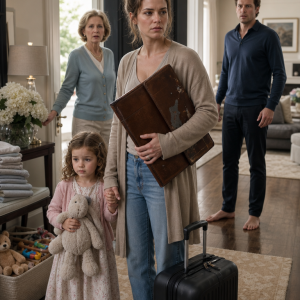
“You can buy my share.”
Silence followed.
Mom took the phone again.
“With what money?”
I looked across Jenna’s living room, where Maisie and Piper were making paper animals.
“I don’t know, Mom. Maybe you can figure it out with all the space you couldn’t find for a five-year-old.”
Then I ended the call.
The family campaign began almost immediately.
Caroline posted vague messages online about selfish relatives and people who “turn their backs on family.”
My mother reacted to every one.
Aunts I had not heard from since Christmas began contacting me.
“Think about your parents.”
“Don’t let one misunderstanding tear everyone apart.”
“Family should matter more than money.”
Not one person asked where Maisie and I had slept that first night.
Dad called after a week.
His voice was quieter.
“Nat, you grew up in this house.”
I watched Maisie coloring at the table.
“I know.”
“There are a lot of memories here.”
“I know that too.”
“Your mother is having a very hard time.”
I nearly laughed, though nothing was funny.
“Dad, Maisie offered to sleep on a couch so she wouldn’t inconvenience anyone. Mom still told her there wasn’t room. Nobody seemed worried about how hard that was for her.”
He had no answer.
Two weeks later, my mother and Caroline formally rejected the offer to buy my share. Their attorney argued that family expenses over the years somehow offset my ownership interest.
Meredith read the letter twice.
Then she looked at me.
“Your parents paid your college tuition?”
“No. I had scholarships and worked part-time.”
One corner of her mouth lifted.
“That argument is going to have problems.”
At the time, I believed that would be the strangest part of the dispute.
I was wrong.
Several days later, Meredith called before lunch.
“Natalie, I need you to look at something I just sent you.”
I opened the attachment.
It was a recorded mortgage connected to my family’s property.
I remembered hearing years earlier that my parents had borrowed against the house.
I had assumed the loan involved only the interests of those who had approved it.
Meredith directed me toward the signature page.
There were several signatures.
My mother’s.
Caroline’s.
My father’s as a borrower and spouse.
And mine.
I stopped breathing for a moment.
The handwriting resembled my signature, but only in the way a carefully traced drawing resembles the original.
The letters were too deliberate.
The angle was wrong.
The final stroke curved in a way mine never did.
“I did not sign this.”
Meredith’s voice became very quiet.
“You’re certain?”
“Completely.”
That changed everything.
The loan had not remained the same over the years. There had been refinancing, additional borrowing and modifications connected to the property.
My supposed approval appeared in records I had never seen.
As the lender reviewed the original file, another problem surfaced. A copy of an old identification card had been submitted with my information, along with a signature that again did not match my current records.
Suddenly, I remembered a family Christmas years earlier when Dad had asked me to email him a copy of my identification.
“It’s just for some house paperwork,” he had said.
I had sent it without asking another question.
Two days after I told Meredith about that memory, she called again.
“We’ve received more of the file.”
I sat down.
“Who handled the paperwork?”
She hesitated.
“Your sister’s name appears repeatedly.”
For the first time, I understood that the dispute had never truly been about a guest room.
The room had simply been where the larger truth became impossible to ignore.
What They Had Been Asking Me to Carry
Over the following weeks, the lender reviewed signatures, identification records, loan applications and earlier modifications. Meredith also arranged for an independent handwriting specialist to examine the signature attributed to me.
The conclusion was straightforward.
It was not mine.
I had never approved using my ownership interest as security for that borrowing.
A mediation meeting was eventually scheduled as part of the property dispute.
My mother arrived dressed as though she were attending a church luncheon. Caroline would not look directly at me. Dad seemed smaller than I remembered.
Their attorney began by talking about family unity, long-term occupancy and the emotional strain caused by the earthquake.
Meredith listened until he finished.
Then she placed the mortgage documents on the table.
“Before we discuss emotions,” she said, “we need to discuss this signature.”
My mother’s face went pale.
Caroline finally looked up.
Dad stared at the table.
The silence lasted several seconds, but I remember it as much longer.
For most of my life, I had been the daughter who adjusted.
That morning, they seemed to realize I was no longer willing to.
Caroline spoke first.
“That paperwork is old.”
I looked at her.
“I didn’t ask how old it was. I asked how my signature got there.”
“It wasn’t like that.”
“Then tell me what it was like.”
Dad finally spoke.
“We needed the loan.”
I turned toward him.
“And that gave you permission to sign for me?”
Mom leaned forward.
“The money benefited the house.”
I stared at her.
“Did it benefit everyone?”
She knew exactly what I meant.
That front porch.
Maisie hiding behind me.
There is no room for her.
Mom shook her head.
“Don’t mix two different things together.”
“You already did. You used my ownership, my payments and apparently my name to support a house occupied by people who later decided my daughter couldn’t stay there for a few nights.”
Caroline slapped her palm against the table.
“You didn’t even live there!”
I nodded slowly.
“Exactly.”
She went quiet.
“I didn’t live there, but I paid every month. I didn’t have a bedroom, but I paid. I wasn’t included in decisions, but I paid. I didn’t know about this mortgage, yet somehow my signature ended up on it.”
Dad rubbed his forehead.
“We thought we could straighten everything out later.”
“When?”
No one answered.
Later.
That word had followed me since childhood.
Later they would come to my school event.
Later they would make things fair.
Later they would help me.
Later they would recognize that Caroline and I were supposed to matter equally.
Later never came.
The records gradually revealed where much of the borrowed money had gone. Some had indeed been used for legitimate repairs, but significant amounts had covered Caroline’s personal bills, Derek’s failed contracting venture, a vehicle, credit-card balances and an expensive kitchen renovation.
Meanwhile, my $450 continued arriving every month because I had been told the family needed help maintaining the property.
Caroline eventually admitted that she had taken part in preparing some of the paperwork. She claimed she believed Dad had already obtained my permission.
Dad said he thought Mom had spoken to me.
Mom said a financial adviser had suggested everything could be corrected later.
Three adults.
Three explanations.
Not one person who had actually called me.
The lender’s position changed once the signature issue was documented. Questions arose about how much of the mortgage could legally attach to my interest in the property.
Meanwhile, the partition case moved forward.
No one could afford to purchase the others’ shares, and a single house could not reasonably be divided into three independent pieces.
Eventually, a sale became unavoidable.
That was when the calls changed from angry to desperate.
Dad called first.
“We can work this out.”
“I’m listening.”
“Stop the sale. We’ll pay you over time.”
“How much?”
A pause.
“Whatever we can manage.”
“For how many years?”
“Natalie…”
I closed my eyes.
“Dad, I’ve spent my whole life accepting whatever you could manage when it came to me.”
Mom called the next day.
“Your sister has three children to think about.”
I looked through Jenna’s kitchen window at Maisie and Piper drawing with sidewalk chalk.
“I have a child too.”
My mother sighed.
Then she said the sentence that finally clarified everything.
“It isn’t the same.”
I became strangely calm.
“Thank you.”
“For what?”
“For finally saying it.”
“Saying what?”
“That this was never about space.”
I ended the call.
That evening, Maisie found me sitting alone on Jenna’s back steps.
“Are you sad?”
“A little.”
She sat beside me, swinging her feet.
“Is Grandma mad because of me?”
My heart tightened.
I turned toward her.
“No. Absolutely not.”