PART 1 — THE ENVELOPE IRENE LEFT BEHIND
Three days after my wife’s funeral, a stranger stood on my front porch holding an envelope with my name written across it in Irene’s handwriting and told me that the woman I had called my wife for sixty years had never legally been my wife at all. I was eighty-six years old, barefoot, holding a mug of coffee I had poured out of habit for a woman who was no longer there, and for several seconds I assumed grief had finally begun playing tricks on me. Then the stranger introduced himself as Martin Geller, an attorney Irene had apparently been seeing without my knowledge, and held the envelope toward me as though he understood that whatever was inside it might alter every room in the house behind me.
“Irene didn’t have an attorney,” I told him.
Mr. Geller shifted his weight but did not lower the envelope. “She did for the last several years. She gave me very specific instructions about when this was to be delivered.”
The statement bothered me almost as much as what he had said about our marriage. Irene and I had shared bank accounts, doctors, children, funerals, vacations and sixty years of ordinary information that married people accumulate until one person’s life becomes almost impossible to explain without mentioning the other. The idea that she had regularly sat across from a lawyer whose name I had never heard seemed ridiculous, yet my name was unmistakably written across the envelope in the looping handwriting I had watched fill grocery lists and birthday cards for most of my adult life.
“What aren’t you telling me?” I asked.
Mr. Geller’s expression tightened. “I think you should read what Irene wrote before I explain anything else.”
I took the envelope and closed the door.
The coffee was cold by the time I opened it at the kitchen table. Irene’s letter began with an apology and then, without any attempt to soften what came next, told me there was something she should have confessed forty-six years earlier. She had been married once before she met me, when she was eighteen, to a high-school boyfriend named Thomas Mercer. The marriage lasted only a few months, and after a miserable stretch of arguments, they separated, signed the papers they believed ended it and went on with their lives.
I knew none of that, but I knew the story Irene and I had told for six decades almost by heart. We met in college, where she sat three rows ahead of me in a history lecture and eventually caught me staring at her. When I finally asked her to dinner, she smiled and said, “Took you long enough.” Less than a year later, after I learned I would be sent overseas with the Army, I asked her to marry me because I could not bear the thought of leaving without making the promise I already knew I wanted to keep.
Our wedding had been so inexpensive that we spent more on gasoline getting there than on the ceremony. Irene wore a white summer dress covered in tiny blue flowers, and afterward we ate hamburgers at a roadside diner because neither of us could afford anything better. On our sixtieth anniversary, only two months before she died, she squeezed my hand beneath the restaurant table and whispered, “Not bad for a cheap diner wedding.”
Now I was sitting alone in the kitchen reading that the wedding had never been legally valid.
According to Irene’s letter, she had genuinely believed her first marriage was over when she married me. Fourteen years later, however, she needed an old record for unrelated paperwork and discovered that the final divorce decree from Thomas had never been properly entered. The papers they had signed existed, but legally the first marriage had remained intact when Irene stood beside me in her flowered dress and promised to be my wife.
I stopped reading because I needed that distinction to matter. If Irene had not known when she married me, then the first fourteen years were an accident, however serious the consequences might have been. We had raised children during those years, bought our first house and built a marriage neither of us had understood was legally defective, and I could imagine the two of us discovering the problem together, being horrified for an afternoon and going to the courthouse the next morning to fix it.
Then I remembered the first sentence of her letter.
There is something I should have told you forty-six years ago.
The arithmetic was simple enough even for a grieving old man. Irene had known for forty-six years.
I called our daughter Penelope because she lived twenty minutes away and had inherited her mother’s irritating ability to hear the difference between “I’m fine” and the truth. When she arrived, she found me at the kitchen table with the letter flattened beneath both palms and Irene’s coffee mug still sitting untouched across from me.
“Dad, what happened?” she asked as she pulled out the chair beside mine.
I pushed the letter toward her. “Your mother was married before me.”
Penelope stared at me, waiting for the rest, so I explained that Irene had married at eighteen and believed she was divorced when we had our wedding. As my daughter read the first page for herself, her expression changed at exactly the same sentence that had stopped me.
“She found out fourteen years after you got married.”
“Yes.”
Penelope looked toward the dates again. “But that was forty-six years ago.”
I nodded, and neither of us said what the numbers meant because we did not need to. Near the bottom of Irene’s letter was one instruction that gave us somewhere else to look: The rest is in the box where I kept the papers I was most afraid you would find.
I knew which cabinet she meant.
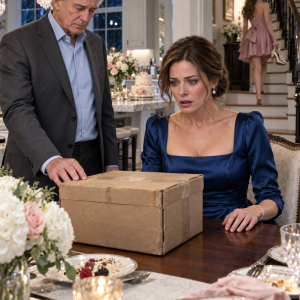
Irene kept important paperwork in an upstairs bedroom cabinet, and although we both used it, she had always organized it because my idea of filing consisted of putting documents into the nearest available drawer. Behind folders containing tax records and insurance statements, Penelope found a small cardboard box pushed against the back panel, hidden well enough that I could have used that cabinet for another ten years without noticing it.
Inside were the papers Irene had hidden from me.
The first document confirmed her marriage to Thomas Mercer, while another showed that the marriage had still been legally active when Irene married me. Beneath those papers was correspondence dated forty-six years earlier between Irene and Thomas, and the first letter from him was so ordinary that for a moment it made the situation even harder to understand. Thomas wrote that he had been shocked too, that he had believed their divorce was complete and that if something needed to be signed to correct the mistake, Irene should send it to him immediately.
There was no secret romance in the letters and no evidence that Irene had been living a second life. Thomas had not been waiting for her, and Irene had not been meeting him behind my back. Two eighteen-year-olds had believed their brief marriage was over, only to discover years later that a legal step had never been completed.
Penelope exhaled beside me. “Okay. So they fixed it?”
I found the final decree beneath Thomas’s letter.
They had.
Forty-six years earlier, Irene and Thomas had legally ended the marriage they had both believed was already over.
Relief moved through me so strongly that I nearly laughed. Whatever had happened during the first fourteen years could now be explained as an administrative failure nobody had intended, and for several seconds I allowed myself to believe that this was the answer Irene had been too frightened to explain properly.
Then Penelope asked the obvious question.
“So after this date, Mom was legally free to marry you?”
I studied the decree. “Yes.”
She waited while I searched through the remaining papers.
There was no second marriage certificate, courthouse receipt or application. There was nothing showing that Irene and I had ever married after she became legally free to do so.
“Dad?” Penelope said quietly.
I sat on the edge of the bed with the cardboard box between my shoes and the decree in my hand. “Fourteen years could have been an accident, Penny. Forty-six years wasn’t.”
The next morning, I called Mr. Geller and asked him to come back.
He arrived shortly after ten, and I put the divorce decree on the kitchen table before he had even removed his coat. I did not want condolences, coffee or another carefully prepared speech from a lawyer who had apparently known more about my marriage than I did.
“Once Irene’s first marriage ended, why didn’t that make ours valid?”
Mr. Geller looked at the document before answering. “Because your original ceremony took place while she was still legally married to someone else. Once that marriage ended, you and Irene would have needed to marry again for a new legal marriage to begin.”
I kept my hand flat against the decree. “So for forty-six years, we were free to marry.”
“Yes.”
“And Irene knew that?”
His hesitation was brief, but it was enough to remove the last possibility I had been holding onto.
“Yes.”
I had spent the previous night trying to convince myself that Irene might have misunderstood what the paperwork meant. Hearing Mr. Geller answer so plainly left me with a much harder question.
“Why didn’t she tell me?”
He folded his hands on the table. “She told me that explanation belonged to you, not to me.”
“She’s dead, Martin. Explanations don’t belong to dead people if they never give them.”
He accepted the anger without defending her, but before leaving he glanced toward the cardboard box and told me I had not read everything Irene had left. After he was gone, I carried the box into the living room and sat in her chair rather than mine, where I found another envelope containing several pages written at different times.
One page began with a date from forty-six years earlier.
Robert, I can marry you now. That should be the happiest sentence I’ve ever written, but first I have to tell you why I couldn’t before.
Nothing came after it.