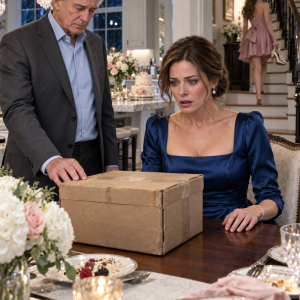
The rest of the page was blank.
Another attempt had been written years later and ended after three paragraphs. Irene wrote that she knew exactly what marriage meant to me because I had insisted we marry before I went overseas, and she remembered me telling her that if something happened to me, I wanted to know I had left this country as her husband.
That page ended unfinished too.
A third draft was written after our thirtieth anniversary, while another appeared after our fortieth. Each one got a little farther, and each one stopped before she reached the confession she had apparently rehearsed for decades.
When Penelope returned that afternoon, she found me holding the earliest unfinished letter. I handed it to her and waited while she read the single paragraph.
“She tried to tell me,” I said.
Penelope returned the page carefully. “Yes, she did.”
I expected her to offer some explanation that would make the letter easier to hold, but instead she remained quiet until I finally said, “She was afraid.”
“I’m sure she was.” Penelope’s voice remained gentle, but she did not rescue her mother from the rest of the truth. “And then she decided not to tell you. Dad, you were scared plenty of times too. You still told Mom things she had a right to know.”
That was the first moment since Mr. Geller appeared at my door when I allowed myself to be angry at Irene without immediately trying to protect her from my own anger. The unfinished letters proved she had loved me enough to fear losing me, but they also proved she had understood the choice she was taking away from me every year she remained silent.
That night, I removed my wedding ring for the first time since Irene’s funeral and placed it beside hers on the dresser. The photograph from our wedding stood nearby in its silver frame, showing Irene in the white dress with blue flowers and me in the suit I had borrowed from my older brother.
I picked up the photograph, looked at the two young people smiling back at me and turned it facedown.
For sixty years, that picture had shown me the beginning of our marriage.
Now I could not look at it without wondering when Irene had stopped believing the same thing.
PART 2 — THE WORD SHE ASKED ME TO KEEP

For the next several days, I treated Irene’s cardboard box like something dangerous enough to require distance. I did not destroy anything, but I stopped rereading the letters because every attempt ended with me trying to interrogate a woman who could no longer answer. A vacation photograph, an anniversary card or even the dent in her favorite chair could send me back into calculations about whether the memory had happened before or after Irene discovered the truth, as though our life had secretly been divided into two marriages even if neither one had legally existed.
What unsettled me most was how normal she had remained after learning what had happened. Forty-six years earlier, when she finally received the decree ending her first marriage, our youngest child had still been in elementary school. Irene had made lunches, attended parent conferences, paid bills and sat beside me on the couch at night while carrying knowledge that could have changed our family with one conversation.
Then another memory returned to me.
Not long after our fortieth anniversary, Irene and I had been washing dishes when she asked an odd question.
“Robert, if somebody kept something from you because they were afraid of losing you, would the reason matter?”
I had been rinsing a plate and barely looked at her. “Depends what they kept from me.”
She smiled in that distracted way she had whenever her mind was somewhere else. “That’s not much of an answer.”
“Then ask me a less mysterious question.”
She never did.
At the time, I assumed she had been thinking about one of our children or something she had heard from a friend. Now I could picture the unfinished letters hidden upstairs and understood that Irene had come close enough to confession to test the ground beneath it.
The memory did not comfort me. It made me wish I had put down the plate.
Mr. Geller called later that week because the cemetery needed final approval for Irene’s grave marker. The draft inscription was simple: her name, the dates of her birth and death and beneath them two words we had chosen years earlier when discussing what we wanted on our stones.
Beloved Wife.
I stared at the proof until those two words began to look unfamiliar.
Then I called him.
“Remove ‘Wife.’ Just use her name and dates.”
There was a brief pause. “If that’s what you want, Robert.”
His tone irritated me because it sounded careful rather than surprised. “You think I’m being cruel?”
“No.”
“You knew her. You must have an opinion.”
Mr. Geller took his time before answering. “My opinion isn’t the one Irene asked me to protect.”
“There you go again.”
“Robert, she didn’t ask me to make you forgive her.”
That stopped me.
I sat down at the kitchen table. “What did she ask you to do?”
“Make sure you knew the truth after she died.”
I laughed once without humor. “So she chose the only moment in sixty years when I couldn’t ask her a question.”
Mr. Geller did not disagree, and before we ended the call I asked when Irene had first come to him. He explained that several years earlier she had become concerned that our marriage status might create confusion after her death, so she wanted her estate organized carefully and her wishes documented regardless of whether the original marriage was recognized.
“Was she protecting me financially?” I asked.
“She was making sure her property passed according to her wishes and that you wouldn’t discover this through some impersonal probate problem before you heard it from her.”
The answer did not excuse anything, but it changed the shape of Irene’s secrecy. She had not been preparing to leave me or hiding a second family; she had been trying to control the consequences of a truth she remained too frightened to tell me while she was alive.
After the call, I opened the cardboard box again.
This time I stopped searching for evidence of another betrayal and began reading Irene’s unfinished drafts in chronological order. The earliest letters concentrated on Thomas and the legal mistake, while the later ones spent more time explaining why she had waited. By the final drafts, she barely discussed the original marriage at all and wrote instead about the shame that had accumulated around her silence.
She had initially convinced herself that telling me immediately would destroy our family, so she decided she would wait until the children were older. When the children reached high school, she worried that a crisis between their parents would disrupt them. When they left for college, she told herself there was no reason to reopen something that had already been legally corrected, and after enough years passed, she became frightened that I would reinterpret our entire marriage as fraudulent.
Twenty years became thirty, and thirty became forty while the secret grew heavier and the practical solution remained almost absurdly simple.
At any point, we could have gone to the courthouse.
That was the part I could not forgive on Irene’s behalf.
One afternoon, Penelope came over carrying groceries and found Irene’s wedding ring still sitting beside mine on the dresser. She did not ask why I had removed my ring, but while putting milk into the refrigerator, she mentioned that her brother and sister were beginning to realize something serious was wrong.
“You should tell them before they invent something worse,” she said.
“What could they possibly invent that’s worse than this?”
Penelope gave me a tired smile. “We’re your children. Give us ten minutes.”
We called them that evening, and I told the story without softening the dates. Irene had been married before me; she genuinely believed the divorce was final when we had our wedding; she discovered the mistake fourteen years later; her first marriage was legally ended; and for the remaining forty-six years of our life together, she knew we had never corrected ours.
My son was silent for so long that I wondered whether the call had dropped.